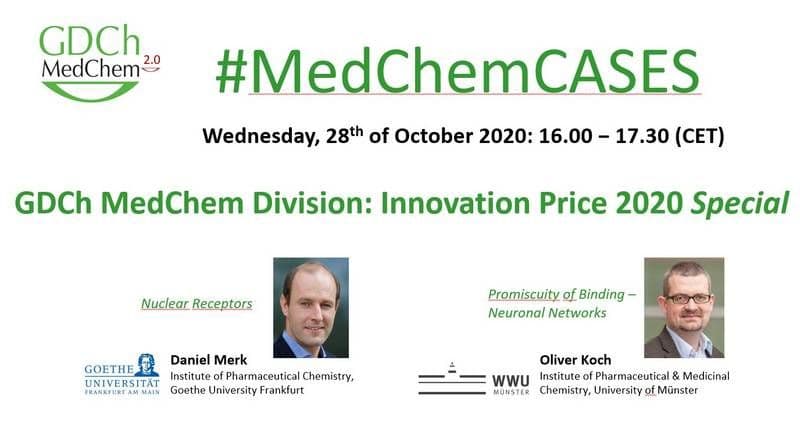
The use of data-driven decisions for rational molecular design; Advances in targeting retinoid X receptors
Veranstaltungen
15:00 – 16:00
Medizinische Chemie
Dies ist ein Online Event
Dr. Oliver Koch, Dr. Daniel Merk
Westfälische Wilhelms-Universität Münster, Goethe University Frankfurt
The increase in the number of protein structures and the enormous amounts of bioactivity data still require new approaches for efficient data mining and knowledge discovery. One focus of my research is (new) data-oriented methods and artificial intelligence for the analysis of protein-ligand interactions and the underlying framework of protein binding sites. The goal is to use this knowledge, the available "big" bioactivity data, and protein structures for computational molecular design and optimization of new bioactive compounds. In the first presented project, our analysis to identify a promiscuous fragment that can be used for fragment-based design approaches is discussed. This result was based on a scaffold analysis of bioactivity data and comparison of binding sites. The second project deals with domain-specific fingerprints generated by neural networks that improve ligand-based virtual screening. The nuclear retinoid X receptors (RXR) act as ligand-sensing transcription factors and hold great promise for neurodegeneration and cancer treatment. However, available RXR agonists exhibit severe adverse effects, have poor properties and lack subtype-selectivity hindering exploitation of this therapeutic potential. We have applied diverse strategies to overcome these obstacles in targeting RXRs. We have observed RXR modulation by several approved drugs, the systematic optimization of which produced potent RXR agonists with superior properties. In the search of subtype-preferential RXR ligands we hypothesized natural products (NP) as promising candidates and discovered valerenic acid as selective RXRβ agonist. Computational de novo design provided several NP-derived subtype-preferential RXR ligand scaffolds and revealed selectivity-driving structural features. Additionally, we have solved the first uniform set of RXR co-crystal structures in active conformation bound to an identical ligand as structural basis for selective RXR agonist design. Our results open avenues to new generations of RXR modulators. Obtaining subtype-selective RXR agonists remains a challenge, however.
Kontaktperson

Alexander Lorey
Zu Ihrem Kalender hinzufügen


Interessen
Veranstaltungsdetails
15:00 – 16:00
Medizinische Chemie
Dies ist ein Online Event
Dr. Oliver Koch, Dr. Daniel Merk
Westfälische Wilhelms-Universität Münster, Goethe University Frankfurt
Kontaktperson
Alexander Lorey
Zu Ihrem Kalender hinzufügen