
Career
Career orientation
Job market
Salary information and income survey
Academy
Mentoring
Education
Learners and trainees
Students and doctoral candidates
Teachers
University statictics
Scholarships
Community
Divisions
Local Sections
Regular's table
Chem_Connect
Equal opportunities, diversity
International activities and cooperations
Membership
Discover
Top topics
Nachrichten aus der Chemie
Brochures and scientific publications
Fascination with chemistry
Statements and position papers
Press releases
Events
Conferences
Local events
Academy
Awards
Prizes
Historical sites of chemistry
About
Board and other bodies
Office
Statutes
Angewandte Chemie and Chemistry Europe
Foundations
ChemRXiv
Honorary membership
The award of honorary membership recognises special services to the Division as an institution and its objectives. This includes commitment to the foundation, existence and expansion as well as the emphatic and lasting promotion of the Division's activities. Honorary membership includes an award certificate, exemption from the Division's annual membership fees and free participation in FGMR Annual Discussion Meetings. Any member of the Division may submit proposals for the appointment of honorary members to the Board of the Division. The proposals must be made in writing, stating the special merits and must be supported by two other members. The Board decides on the awarding of honorary membership.
Honourary Members
2024: Prof. Dr Thomas F. Prisner
2023: Prof. Dr Harald Günther
2022: Prof. Dr Dr h.c. mult. Wolfgang Lubitz
2022: Prof. Dr Stefan Berger†
2020: Prof. Dr h.c. mult. Tony Keller†
2014: Prof. Dr Robert Guy Griffin
2010: Prof. Dr Dr Dr h.c. mult. Horst Kessler
1998: Prof. Dr Dr h.c. mult. Richard R. Ernst†
Prof. Dr Robert Kosfeld†
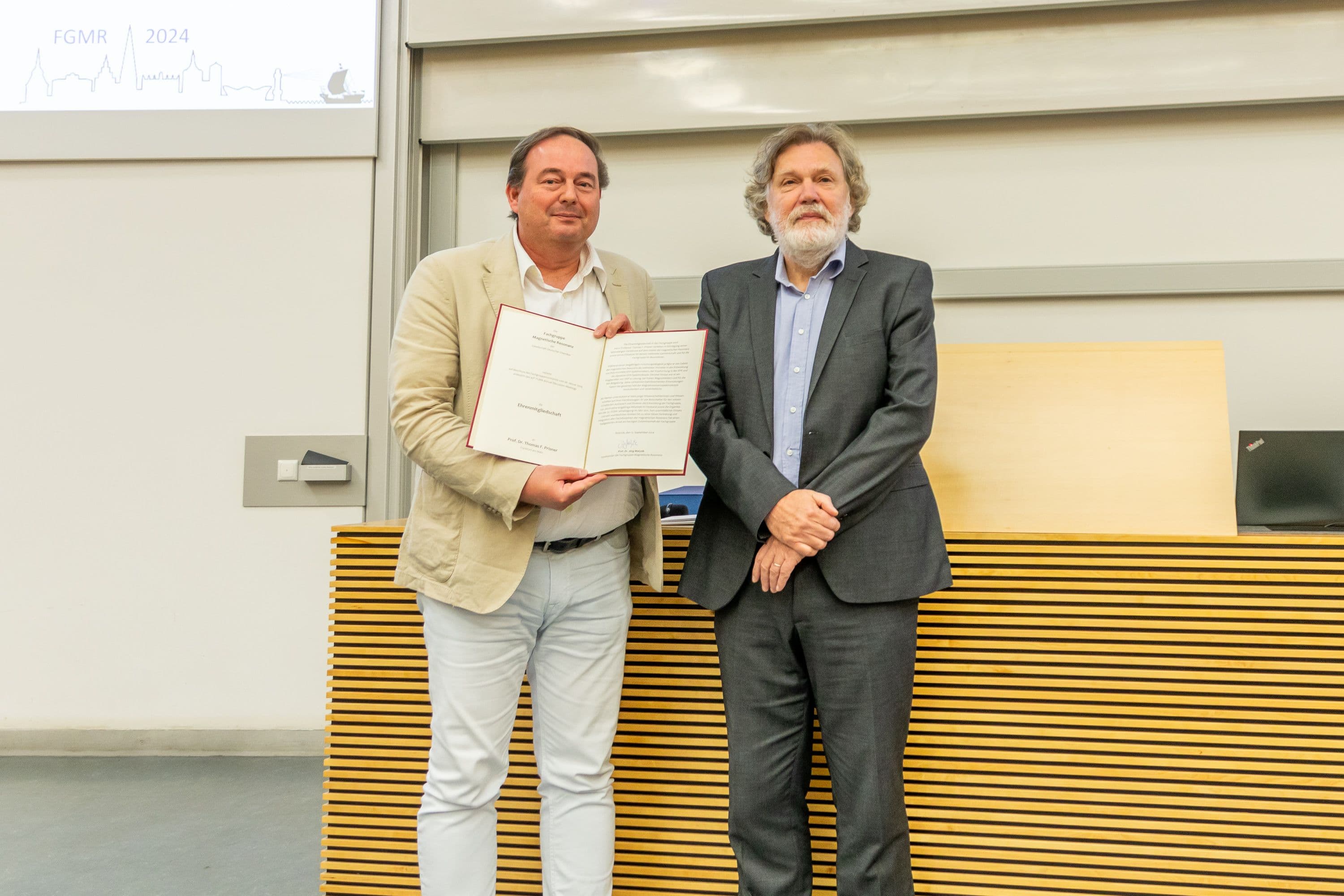
Awarded on 12 September 2024 during the FGMR Annual Discussion Meeting in Rostock "...in recognition of his lifelong contributions to the field of magnetic resonance and his dedication to its worldwide community and to the Division in particular. During his many years of research, he shaped the field of magnetic resonance as a worldwide pioneer in the development of pulsed high-field EPR spectrometers, pulse shaping in EPR and dipolar EPR spectroscopy. He was also a pioneer of DNP in solution, at high magnetic fields and for MR imaging. His numerous groundbreaking developments have revolutionised and unified the entire field of magnetic resonance spectroscopy. As a mentor, he always supported young scientists on their career paths. He was an ambassador for scientific exchange and promoted the development of the Division, including through his many years on the Board and the organisation of the 33rd FGMR Annual Meeting in 2011. His tireless commitment and his indispensable efforts towards fair representation and integration of all disciplines of magnetic resonance have played a significant role in the cohesion of the Division today."
.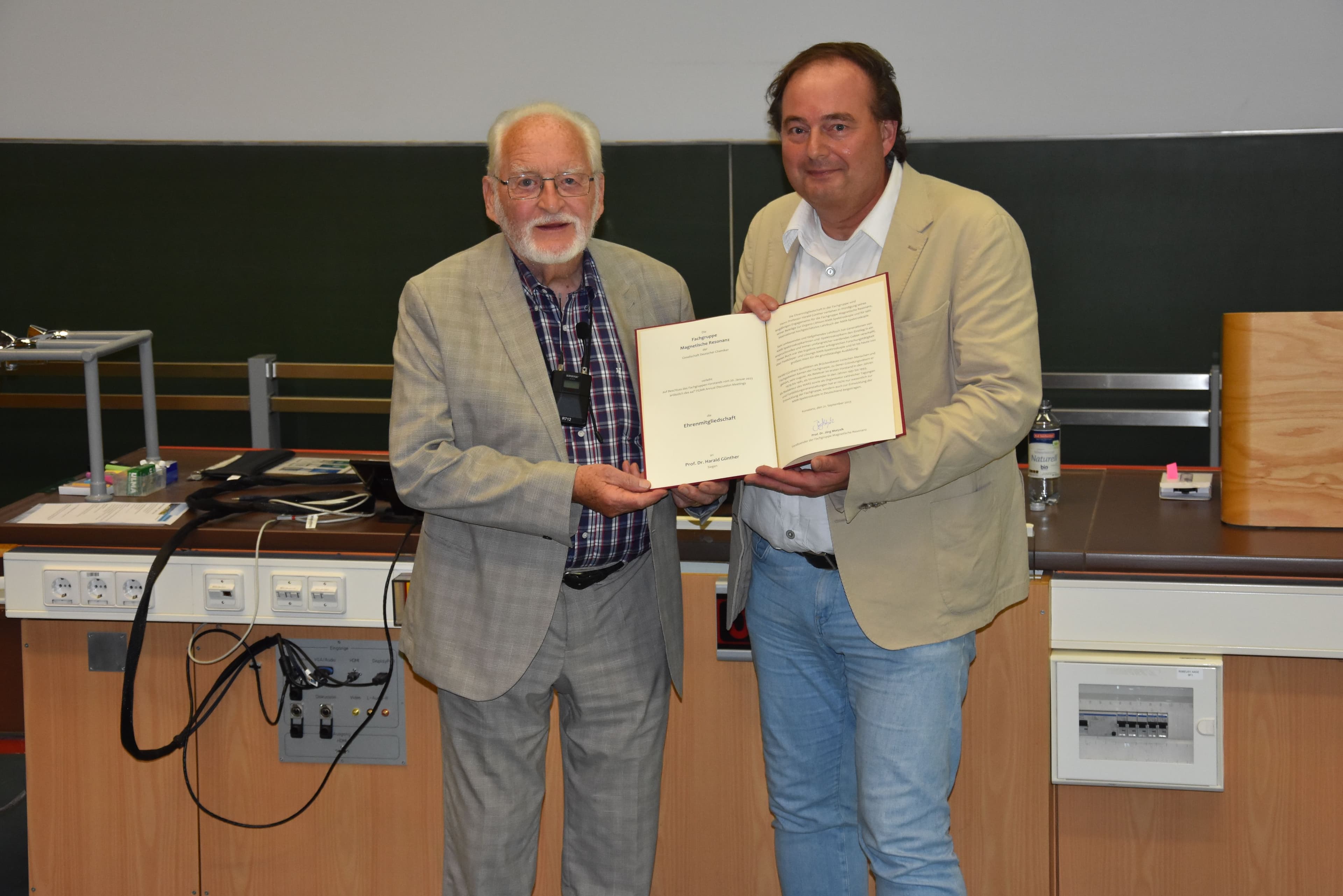
Awarded on 21 September 2023 during the FGMR Annual Discussion Meeting in Konstanz: "...in appreciation of his many years of commitment to the Magnetic Resonance Division, his contributions to organo-lithium NMR spectroscopy and for his internationally highly regarded textbook on NMR spectroscopy. His comprehensive and in-depth textbook has provided generations of NMR spectroscopists with an introduction to a challenging and ever-expanding field. This book was the result of his successful research work on solid-state and solution NMR spectroscopy and is still of great value for undergraduate education today. Harald Günther's qualities as a bridge builder between people and disciplines greatly benefited the Division, of which he was one of the founding fathers. As an assessor on the first Board from 1979 to 1981, as Chairman from 1991 to 1993, as editor of MARS and as the organiser of numerous conferences and training events, he not only contributed significantly to the development of the Division, but also to the development of NMR spectroscopy in Germany."
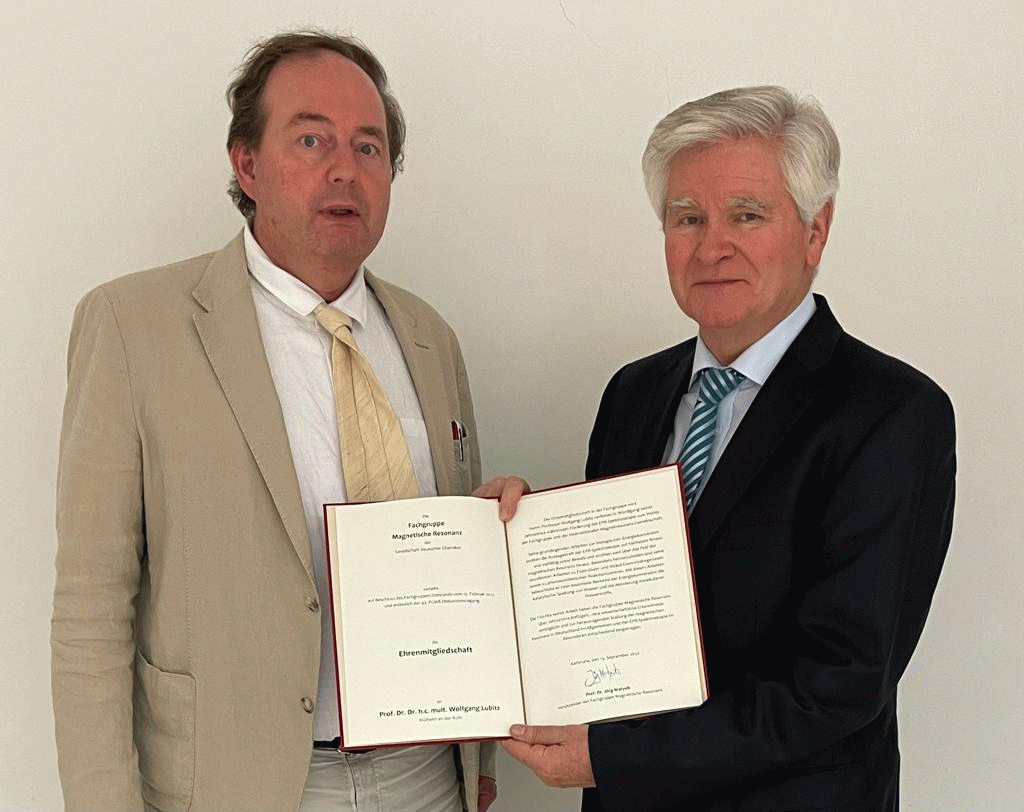
Awarded on 15 September 2022 at the FGMR Annual Discussion Meeting in Karlsruhe: "...in recognition of his decades-long promotion of EPR spectroscopy for the benefit of the Division and the international magnetic resonance community. His fundamental work on biological energy conversion has demonstrated the informative value of EPR spectroscopy at the highest level and in a variety of ways and shines far beyond the field of magnetic resonance. His excellent work on iron-iron and nickel-iron hydrogenases and on photosynthetic reaction centres is particularly noteworthy. With this work, he shed light on two essential areas of energy conversion: the catalytic splitting of water and the activation of molecular hydrogen. The fruits of his labour have inspired the Division of Magnetic Resonance for decades, made many scientific findings possible and contributed decisively to the outstanding position of magnetic resonance in Germany in general and EPR spectroscopy in particular."
.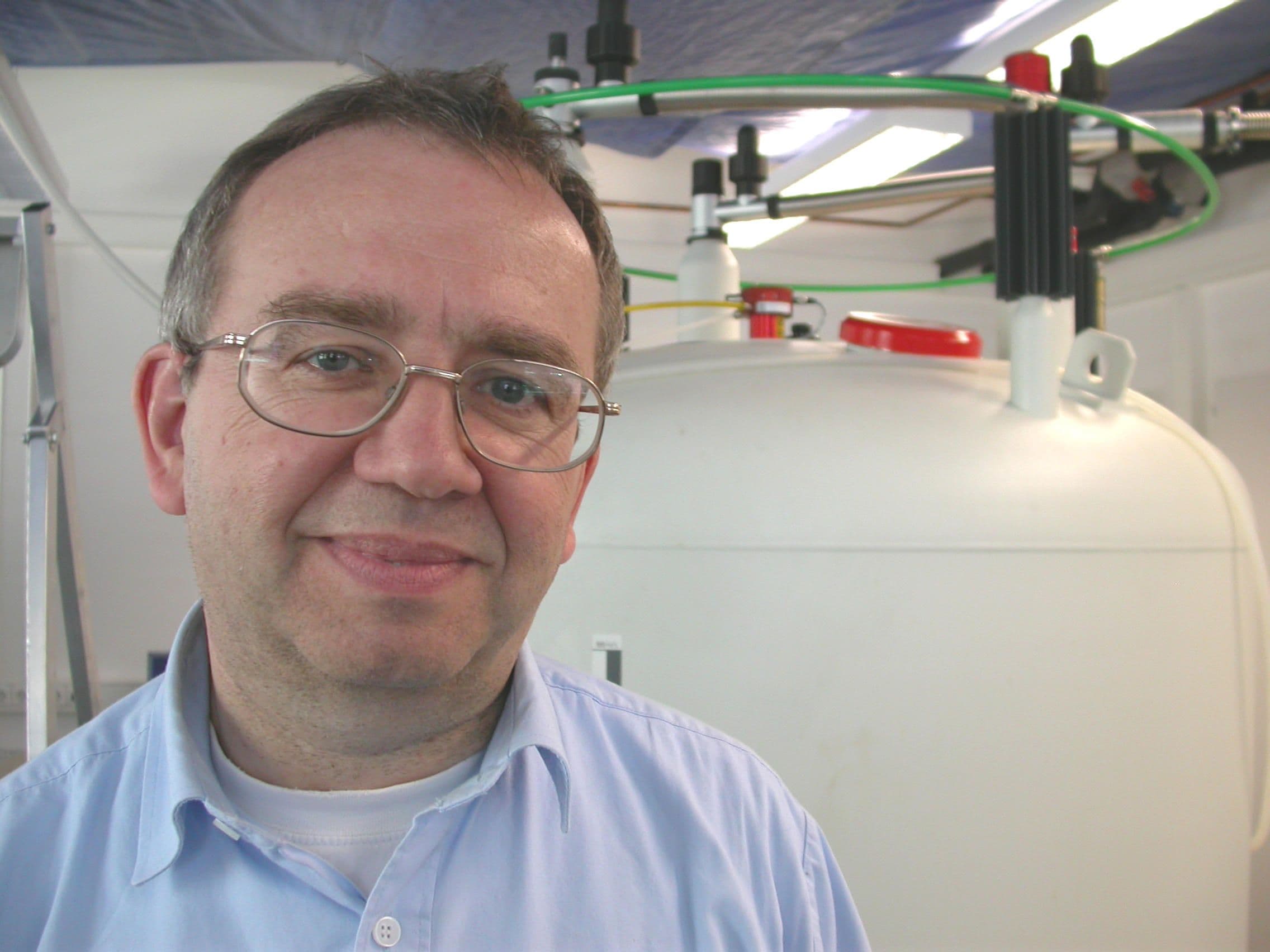
Presented on 9 May 2022 by Profs Jörg Matysik and Burkhard Luy: "...in appreciation of his lasting methodological and technical contributions, his many years of commitment to the Magnetic Resonance Division and his many decades of outstanding teaching activities in the field of nuclear magnetic resonance. His achievements have promoted the understanding of NMR spectroscopy, the interpretation of NMR data and the targeted application of experiments, even by less experienced users, to an extraordinary degree and have thus contributed substantially to the dissemination of NMR and the benefits of this versatile technique across disciplinary boundaries. Above all, his numerous book publications, which facilitate the practice of NMR spectrometry for beginners as well as experts, and the detailed collection of NMR parameters in overviews, which have already served generations of scientists as a helpful reference work, bear witness to his special achievements. The fruits of his labour have inspired the Division of Magnetic Resonance for decades, made many scientific findings possible and contributed decisively to the outstanding position of magnetic resonance in Germany." (Photo: M. Findeisen, 2009)
.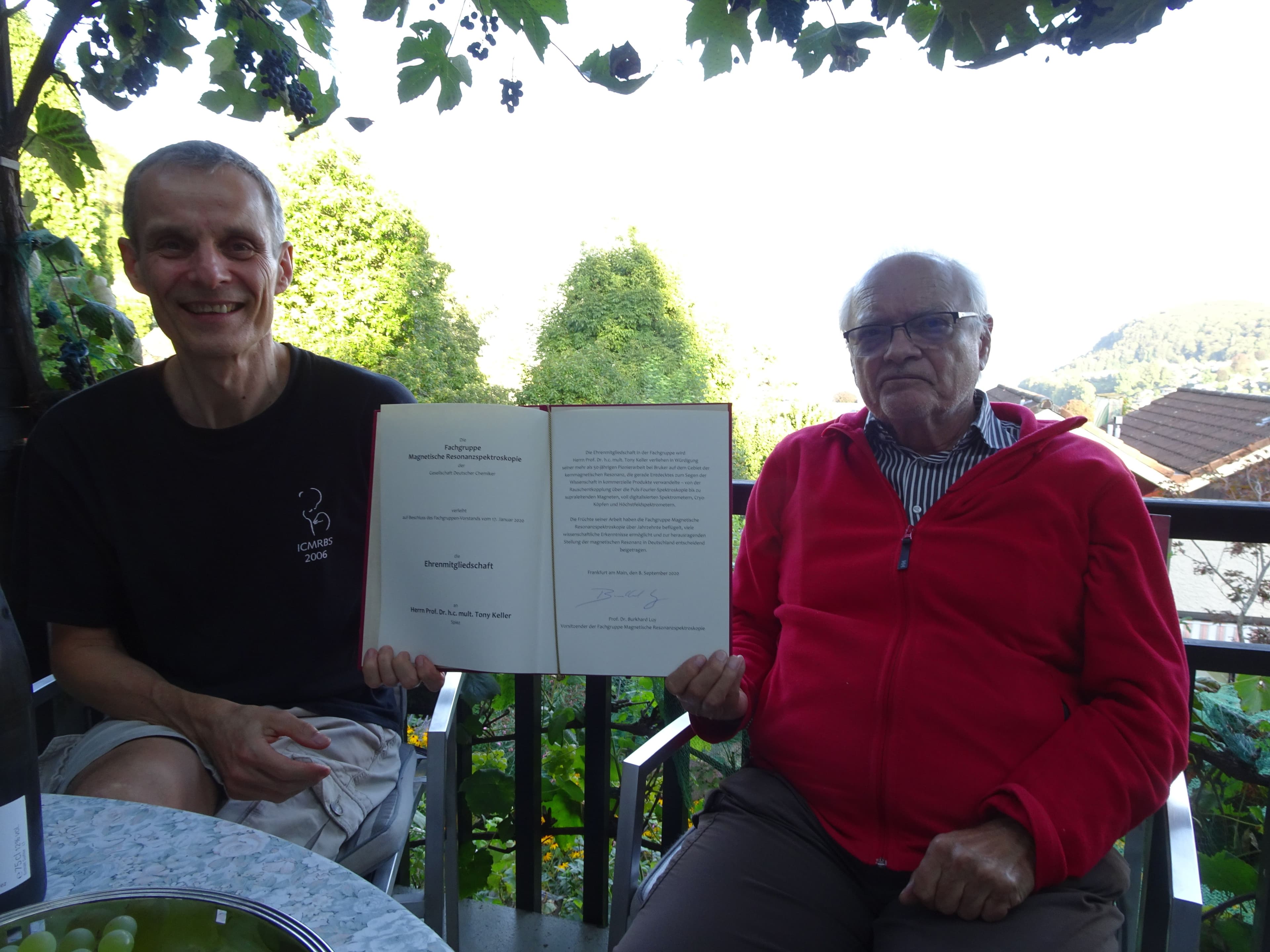
Presented on 8 September 2020 by Prof. Dr Christian Griesinger: "...in recognition of his more than 50 years of pioneering work at Bruker in the field of nuclear magnetic resonance, transforming what had just been discovered into commercial products for the benefit of science - from noise decoupling and pulse Fourier spectroscopy to superconducting magnets, fully digitised spectrometers, cryo-heads and high-field spectrometers. The fruits of his labour have inspired the Division of Magnetic Resonance Spectroscopy for decades, made many scientific findings possible and contributed decisively to the outstanding position of magnetic resonance in Germany." (Photo: C. Griesinger)
.Awarded on 30 September 2014 at the FGMR Lecture Conference in Berlin: "...for his outstanding contributions to the field of magnetic resonance. He is the father of dipolar recoupling sequences and established dynamic nuclear polarisation in solid-state NMR for applications in biological sciences. His fundamental work on dynamic nuclear polarization required a combination of state-of-the-art NMR and EPR techniques. He has driven dynamic nuclear polarization in the solid to a useful method for approximately 20 years. The investigation of the DNP effect in solids required basic understanding of magnetic resonance phenomena and in addition chemistry to implement the most efficient polarisation transfer mechanisms with the least power and with biradicals of the correct geometry and rigidity as well as solubility. His instrumental design became commercially available and was adopted by numerous research groups. Bob Griffin has applied his methods to the study of highly relevant biological problems such as amyloids and the photocycle of bacteriorhodopsin. He has contributed to educating several excellent scientists, who have a leading role in magnetic resonance in Germany."
Awarded on 22 September 2010 during the FGMR Lecture Conference in Münster: "...in recognition of his continuous commitment to both the founding and the successful continuation of the Division as well as his many national and international services to the field."
.
Awarded on 29 September 1998 in Obernai during the Franco-German NMR Conference II: "...in recognition of his pioneering contributions to the development of magnetic resonance over more than three decades, which have made magnetic resonance the most important means of elucidating the structure and dynamics of molecules in solution and in the solid state, in materials science and the life sciences and for imaging in medicine, in particular for the introduction of Fourier-transform NMR spectroscopy, of multidimensional NMR spectroscopy, of multidimensional imaging experiments of polarisation transfer techniques in solution and in the solid state and of the systematic investigation of the dynamics of molecules. The Division thus honours one of the most outstanding researchers in the natural sciences, who has distinguished himself not only through his scientific contributions, but also through his commitment to magnetic resonance and its instrumental developments, as well as his advocacy for the development of basic research in the public sphere."
.
Obituary (Harald Günther; MARS 2008, 22)
On 13 December 2007, our founding and honorary member Dr Robert Kosfeld, Professor Emeritus of Physical Chemistry at the University of Duisburg, passed away after a long and serious illness. Robert Kosfeld came from Iserlohn and studied physics in Bonn. After gaining his doctorate in 1958, he worked as a research assistant at the Institute of Physical Chemistry at RWTH Aachen University, where he qualified as a professor in 1967. In 1971, he was appointed Scientific Counsellor and Professor and in 1972 Associate Professor. In 1974, he was appointed to the Chair of Physical Chemistry at the University of Duisburg. His scientific interests focussed on polymer chemistry and the diverse applications of NMR spectroscopy in this field. He set up an efficient NMR laboratory in Aachen, which soon became known as a centre for Conferences and training courses. Here he was a tireless and restless organiser, for whom contact between NMR spectroscopists from the most diverse fields was always an important concern, even between those who were separated by the division of Germany. The Aachen colloquia on NMR spectroscopy, often organised with international participation, soon had a firm place in the spectroscopists' conference calendar and set important accents for the emerging field of research, e.g. in 1969 for investigations in liquid crystals. Always open to new ideas, his commitment made it possible for a Bruker device for recording C-13 Fourier transform spectra to be used by the scientific community for the first time in 1970 during an advanced training course in Aachen. He was one of the founders and editors of the monograph series "NMR Spectroscopy - Basic Principles and Progress" and was a member of the Advisory Board of Magnetic Resonance in Chemistry. He was also a driving force in the preparations for the founding of our Division and took part in the first meetings of the "NMR Club" in Frankfurt in 1974. From 1985 to 1990, he was then Chairman of the Division and, among other things, the organiser of the 1990 Conference in Todtmoos, at which the merger of NMR spectroscopists from East and West was prepared. Even after his retirement, when illness no longer allowed him to actively participate, he took an active interest in the progress of the Division. Robert Kosfeld has sustainably promoted the positive development of NMR spectroscopy in our country at various levels. We will always remember him with gratitude.