
Career
Career orientation
Job market
Salary information and income survey
Academy
Mentoring
Education
Learners and trainees
Students and doctoral candidates
Teachers
University statictics
Scholarships
Community
Divisions
Local Sections
Regular's table
Chem_Connect
Equal opportunities, diversity
International activities and cooperations
Membership
Discover
Top topics
Nachrichten aus der Chemie
Brochures and scientific publications
Fascination with chemistry
Statements and position papers
Press releases
Events
Conferences
Local events
Academy
Awards
Prizes
Historical sites of chemistry
About
Board and other bodies
Office
Statutes
Angewandte Chemie and Chemistry Europe
Foundations
ChemRXiv
Annual conference
Between crisis and change: Pollutants, health and ecosystems in the Anthropocene
02-04 September 2026
Essen
Chemical Universe Meets Planetary Boundaries The joint annual conference of the GDCh Division of Environmental Chemistry & Ecotoxicology and SETAC GLB will take place from 22 to 24 September 2025 at the headquarters of the Federal Environment Agency (UBA) in Dessau-Roßlau. Under the motto "Chemical universe meets planetary boundaries", the Conference will focus on the problem that our modern life is inconceivable without chemical substances and their diverse applications - but that their release into the environment has far-reaching consequences. From increasing concentrations of persistent pollutants in soil and water to atmospheric pollution, chemical substances contribute to disturbing the earth's natural balance with potentially irreversible consequences for humans and the environment.
From lecture theatre to practice & from laboratory to field scale. The "Umwelt" is the joint annual conference of the GDCh Division of Environmental Chemistry & Ecotoxicology and the SETAC GLB. The 2024 edition took place from 8 to 11 September 2024 in Giessen and Homberg (Ohm). As always, non-members were very welcome. In addition to classic sessions in the lecture theatre, there was, as 10 years ago, a field day where methods were practically demonstrated and discussed. It was also possible to demonstrate your own methods.
Flyer
Conference proceedings
Together against global pollution: education and research for clean solutions What effects do different chemicals have on humans, organisms and entire ecosystems? To answer this question, suitable methods must be developed, optimised and applied to achieve reliable results at various levels. Risk assessments are carried out and communicated on the basis of this data - with the aim of preventing or remedying damage. However, a sober look at the past and the current global situation raises doubts as to whether our current approaches will be sufficient in the future to avoid further negative effects and enable action that is adequate on a global scale. To make this possible, applied solutions must be developed in cooperation with all stakeholders. As the degree of global networking and complexity increases, so does the need for networked thinking and inter- and transdisciplinary cooperation in order to offer suitable solutions. With this in mind, the joint annual meeting of SETAC-GLB and the GDCh Division of Environmental Chemistry & Ecotoxicology 2023 in Muttenz focused on common ground: We want to promote the networking and training of experts so that sustainable solutions against global environmental pollution are our future.
Flyer
Conference proceedings
Buten und Binnen. After two years without a face-to-face meeting of the Division, the Annual Conference Environment 2022 took place from 5 to 7 September 2022 at the Emden/Leer University of Applied Sciences in Emden under the motto "Buten und Binnen - Stoffkreisläufe in Luft / im Meer / an Land". The scientific programme was once again jointly organised by the GDCh Division of Environmental Chemistry & Ecotoxicology and the SETAC GLB. The Conference focussed on material cycles, with "Buten und Binnen" meaning "outside and inside".
Flyer
Conference proceedings
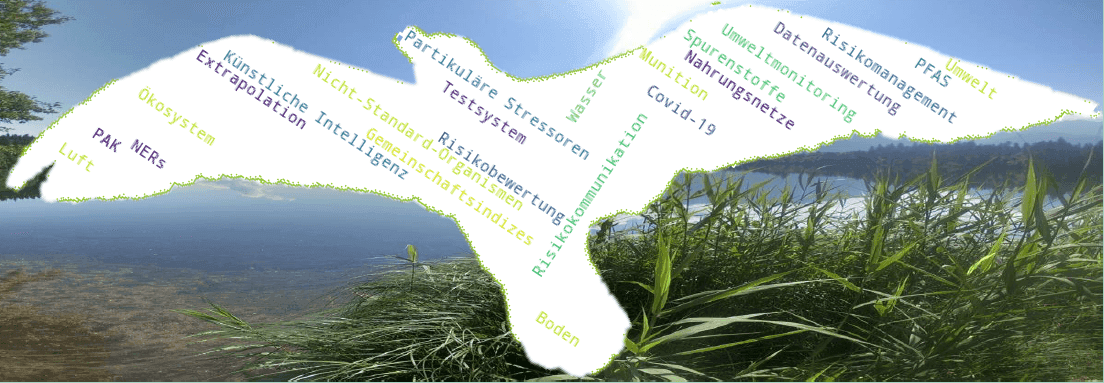
Under the motto "Anthropogenic Substances in a Changing World - Assessment on the Test Bench of Reality", the Environment 2021 Conference took place virtually on 7/8 September 2021. The scientific programme was jointly organised by the GDCh Division of Environmental Chemistry & Ecotoxicology and the SETAC GLB.
Flyer
Programme
Unfortunately, the Environment 2020 Conference had to be cancelled or postponed to 2021 due to the coronavirus pandemic.
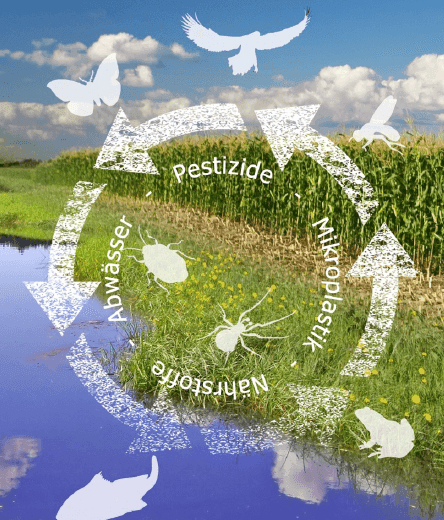
Biodiversity in water and on land - the role of chemical stressors The biodiversity crisis is on everyone's lips and almost every day, the public is bombarded with news: fungal diseases wipe out amphibians, wind turbines kill birds of prey, invasive species jeopardise native flora and fauna. Chemicals are also in the spotlight here. Neonicotinoids are suspected of contributing to bee mortality, PCBs accumulate in charismatic mammals and glyphosate has even been detected in humans. However, questions about the role of chemical stressors in the context of multiple stressors and the extent to which they actually contribute to the decline in biodiversity in water and on land are rarely discussed in the media. They are also far from being clearly clarified in the scientific discourse. The Conferences were dedicated to these topics.
Flyer
Proceedings
The Environment 2018 was organised with the support of the Divisions and the SETAC GLB at the University of Münster. Conferences covered new analytical techniques and methods and their applications in the context of environmental chemistry and ecotoxicology, the occurrence and behaviour of pollutants and trace substances in surface water, groundwater, soil, sediments and air, their accumulation, transformation and effects on terrestrial and aquatic organisms, taking into account various mechanisms of action and test methods, as well as concepts of assessment and regulation (e.g. reassessment of PAHs in the new EU Directive on the Assessment of Pollutants).
Flyer
Programme
Annual conference 2016 with SETAC GLB: "Many substances - great risk?"
How relevant are trace substances for humans and the environment? This question was at the centre of the interesting specialist event. In particular, the Division organised the session: "Coals and carbonaceous substrates - behaviour in the environment and pollutant binding"
Flyer
Programme
15th EuChemS International Conference on Chemistry and the Environment
The most important conference on the topic of environmental chemistry and ecotoxicology, the ICCE (2013 in Barcelona, 2011 in Zurich and 2009 in Stockholm) took place in Leipzig in 2015 with the participation of the Division and replaced the separate annual conference.
"Researching fundamentals, applying findings, imparting knowledge"
"Courage to take risks" must have been the guiding principle of the hosts of this year's Annual Conference on Environmental Chemistry and Ecotoxicology in Giessen, Prof Rolf-Alexander Düring and Prof Klaus Peter Ebke, when they decided to deviate from the previous conference concept based exclusively on lectures and posters and set aside a day for practical demonstrations in the form of outdoor sessions. Their courage was rewarded with a lot of positive feedback from the almost 300 registered participants.
Flyer
Conference proceedings
The planned annual meeting of the GDCh Division in Wuppertal had to be cancelled at short notice due to insufficient registrations. The Board of the Division was therefore very grateful that the colleagues from Essen spontaneously offered to host the GDCh colleagues who had registered their contributions for Wuppertal. This meant that the number of registrations, which had also fallen slightly at SETAC GLB, could be filled by the additional GDCh contributions.
From 10-13 September 2012, more than 200 scientists met at the Helmholtz Centre for Environmental Research (UFZ) in Leipzig for the 5th Joint Annual Meeting of SETAC GLB and the GDCh Division of Environmental Chemistry and Ecotoxicology, which was held under the motto "Recognising, Investigating, Modelling - The Benefits of Understanding".
Flyer
Conference proceedings
Participation in the 13th European Environmental Chemistry Conference of EuChemS, ICCE
In place of a conventional annual conference or a joint conference with SETAC, the Division took part in the 13th European Environmental Chemistry Conference of EuChemS, ICCE in 2011. The main organiser of the ICCE is the Division of Chemistry and the Environment of EuChemS. Thomas Knacker and Gerhard Lammel were members of the organising committee on behalf of the Division. In 2011, this conference was the European version of the annual conference.
4th Joint Annual Conference with SETAC-GLB: Environment 2010 - From Knowledge to Decision
For the first time, the Federal Environment Agency took over the conference organisation and proved that it is just as up to the task as the previous academic organisers. The Division's publication prize was also awarded at the Conference. To anticipate this: The local organising committee provided this proof, which cannot have been easy given that there were around 350 participants and around 100 presentations. This was due not only to the exemplary organisation and the varied supporting programme, but also to the inspiring atmosphere of the conference building - the UBA headquarters in Dessau.
In line with the broad orientation of the conference, many aspects of the entry, behaviour and effects of chemicals in water, soil and air were covered in around 70 presentations and over 60 posters. The topics "Monitoring and monitoring networks", "Environmental sample banks", "Atmospheric chemistry, tropospheric aerosol", "Soil pollution" and "Environmental analytics" crystallised as focal points.
3rd Joint Annual Meeting of SETAC-GLB and GDCh Division of Environmental Chemistry & Ecotoxicology: "New problematic substances in the environment - detection, effects, solutions"
The overarching theme of this year's Conferences was "New problematic substances in the environment - detection, effects and possible solutions". The focus was on pharmaceuticals, perfluorinated chemicals, pesticides and nanoparticles, for example. New problematic substances" are substances that have either only recently been released into the environment or have been present in the environment for decades and have only recently been recognised as problematic. The 300 participants from both societies impressively demonstrated how important this topic is.
"From chemodynamics in ecosystems to substance assessment. Methods, concepts and assessments in the service of sustainable development"
The annual conference ranged from substance transformations in individual environmental compartments to substance assessment and from local to global problems. Methods, concepts and assessments were presented and discussed by the 180 participants in around 60 presentations and almost 70 poster contributions. The scientific committee chaired by Prof. Dr Michael Matthies, Institute for Environmental Systems Research at the University of Osnabrück, was responsible for the programme.
The Division conference took place on the premises of Martin Luther University Halle-Wittenberg. In contrast to previous years, it was not a meeting of several Divisions or a lecture block within the GDCh Annual Meeting, but an independently organised event. The range of topics was broad in order to take into account as many current developments as possible in the field of environmental and pollutant research as well as sustainable chemistry and consumer protection. The leitmotif "Modern man in the ecosphere and technosphere" built on the tradition of previous events.
2nd Joint Annual Conference with SETAC-GLB: "Finding boundaries, overcoming boundaries - molecular mechanisms and ecosystem processes"
The colourful and interdisciplinary programme with 85 posters and 75 lectures offered a comprehensive overview of current environmental pollutant research and attracted 280 participants to the imperial city of Aachen. Fortunately, the Dutch scientific organisations KNCV-MC (Royal Dutch Chemistry Society - Environmental Chemistry Section), VVM (Netherlands Association of Environmental Professionals), NVT-MT (Dutch Toxicology Society - Environmental Toxicology) and the European association FECS (Federation of European Chemical Societies and Professional Institutions) were also involved in organising the conference programme this time. The mixed English and German-language Conference was also attended by 30 scientists from other European countries.
Chemistry, toxicology and the environment
Under the umbrella of the 2003 GDCh Annual Meeting in Munich, the Division was involved in organising the content of three half days (Tuesday afternoon and Wednesday morning and afternoon). The event was organised under the motto "Chemistry, Toxicology and the Environment" in order to incorporate current developments in the field of molecular toxicology and at the same time to take into account the current discussion within the Division on a stronger integration of toxicological issues and their relation to environmental chemistry.
1st Joint Annual Meeting with the Society of Environmental Toxicology and Chemistry (SETAC, German Language Branch): "Research and Development in the Service of Environmental and Consumer Protection"
In addition to overview lectures, a large number of lectures and posters were presented at the annual conference on the topics of: Ecosystem and Material Flow Analysis/ Modelling, Consumer Protection/Toxicology, Aquatic and Terrestrial Systems (environmental monitoring, biocidal chemicals, ecotoxicological test systems), Atmosphere/Climate, Risk Assessment/Risk Minimisation and Sustainable Chemistry, Technology and Education were presented.