Career
Career orientation
Job market
Salary information and income survey
Academy
Mentoring
Education
Learners and trainees
Students and doctoral candidates
Teachers
University statictics
Scholarships
Community
Divisions
Local Sections
Regular's table
Chem_Connect
Equal opportunities, diversity
International activities and cooperations
Membership
Discover
Top topics
Nachrichten aus der Chemie
Brochures and scientific publications
Fascination with chemistry
Statements and position papers
Press releases
Events
Conferences
Local events
Academy
Awards
Prizes
Historical sites of chemistry
About
Board and other bodies
Office
Statutes
Angewandte Chemie and Chemistry Europe
Foundations
ChemRXiv
Follow-up report feb. 2025
From 21 to 23 February 2025, the Rhineland-Palatinate University of Technology Kaiserslautern-Landau (RPTU) hosted this year's conference for young researchers of the Division of Chemical Education (FGCU) of the German Chemical Society (GDCh) at the Kaiserslautern campus. The event, which was entitled "Presenting science - from paper to lecture" offered 15 young scientists in chemistry didactics a platform for intensive professional exchange, practical workshops and joint scientific work.
.A varied programme to promote scientific skills
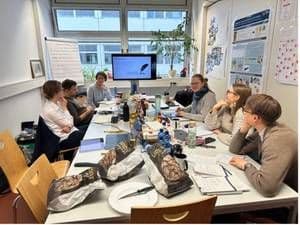
The Writing Weekend combined practice-oriented work phases with high-calibre lectures by experienced scientists. The event kicked off on Friday with a workshop by PD Dr Nadja Belova, who discussed the value and evaluation of publication achievements in science didactics. The evening ended with an informal exchange in a convivial atmosphere with pizza and an evening of games.
On Saturday, Prof Dr Barbara Geist, Professor of Didactics of German Teaching: Language Didactics, offered science-based impulses on the use of dictation functions and handwriting recognition in academic writing. A joint writing phase and a lunch break with kebab and falafel were followed by a lecture by Prof. Dr Sara Hägi-Mead, Professor of German as a Foreign Language and Multilingual Didactics, who shed light on writing as a process. In the evening, a joint closing dinner was held at the Spinnrädl in Kaiserslautern, which provided the setting for further networking.
Another forward-looking topic was addressed on Sunday by Dr Sabrina Syskowski : Her talk was about the use of artificial intelligence (AI) in scientific work, an aspect that is becoming increasingly important in modern science.
Hybrid participation and productive work
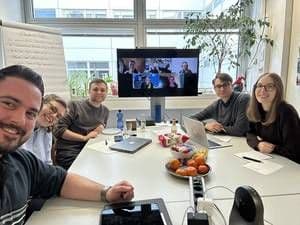
In order to enable as many early career researchers as possible to participate, the event was offered in hybrid form. This meant that all keynote speeches could also be followed online. In addition to the presentations, the focus was on individual work on their own scientific texts. Participants made intensive use of the writing phases to work on their projects with the support of the specialist community.
Successful networking and positive feedback
The event was very well received by the participants. The constructive and productive working atmosphere, the professional impetus and the opportunity to network with other early career researchers were particularly emphasised. The mixture of theory and practice, accompanied by valuable expert contributions, provided the ideal framework for productive and collaborative work. Further impressions can be heard in the following podcast excerpt: rptu.de/s/odqxbt
The Young Scientists' Conference has proven to be an important platform for young scientists in chemistry didactics . The AG Nachwuchs of the GDCh Division of Chemical Education is already looking forward to the next event in November 2025 and cordially invites all interested parties to actively participate in the community.
.