
Career
Career orientation
Job market
Salary information and income survey
Academy
Mentoring
Education
Learners and trainees
Students and doctoral candidates
Teachers
University statictics
Scholarships
Community
Divisions
Local Sections
Regular's table
Chem_Connect
Equal opportunities, diversity
International activities and cooperations
Membership
Discover
Top topics
Nachrichten aus der Chemie
Brochures and scientific publications
Fascination with chemistry
Statements and position papers
Press releases
Events
Conferences
Local events
Academy
Awards
Prizes
Historical sites of chemistry
About
Board and other bodies
Office
Statutes
Angewandte Chemie and Chemistry Europe
Foundations
ChemRXiv
events
New Frontiers in Chemical Biology and Biochemistry
Chair: S. Raunser
Programme
Molecules of Life - Molecules in Life
Joint Symposium of the GDCh Division of Biochemistry and Liebig Association for Organic Chemistry and the Joint Working Group Chemical Biology
Session I
- Photoswitches for reversible control of gene expression (O. Vazquez, Marburg)
- Weak effects on electron transfer reactions (S. Landgraf, Graz)
- iSPAAC: isomer-free strain-promoted azide-alkyne cycloaddition for generating large inhibitors of protein-protein interactions (T. Berg, Leipzig)
- From Peptido RNA to Translation (C. Richert, Stuttgart)
- "Multilingual enzymes": Dissecting specificity in the ubiquitin system through chemical biology (M. Gersch, Dortmund)
Session II
- Robust Fluorescent Light-up Aptamers for Super-resolution Microscopy (F. Grün, Heidelberg)
- In situ detection of the strain-induced radicals in human hair: Combined EPR-strain technique (E. Dmitrieva, Dresden)
- Förderpreise Biochemie 2023 der GDCh Division of Biochemistry
Session III
- A versatile "Synthesis Tag" (SynTag) for chemical protein synthesis (N. Hartrampf, Zurich)
- Drifting in the structure of cell penetrating DNA- and RNA-binding nucleopeptides (S. Tomassi, Naples)
- Custom-tailored Ligands to Visualise Cell Surface Proteins in vivo (J. Broichhagen, Berlin)
- Supramolecular Medicine: From basic research to gluten-related disorders (V. Dodero, Bielefeld)
Chemical Biology of Nucleic Acids & Proteins
Chairs: A. Rentmeister, H.D. Mootz
Programme
Molecules of Life - Molecules in Life
Organised by the GDCh Divisions of Biochemistry and Liebig Association and the Joint Working Group Chemical Biology.
Session I - Chairs: Andrea Rentmeister, Pierre Stallforth
- Novel approaches to RNA imaging in live cells (A. Jäschke, Heidelberg)
- Interdisciplinary approaches to reveal parasite vulnerabilities (E. Derbyshire, Durham/UK)
- Presentation of the Young Scientist Award Biochemistry 2021 of the GDCh Division of Biochemistry
- Structure-based design and optimisation of SARS-CoV-2 main protease inhibitors (L. Zhang, Lübeck)
- Development, characterisation, and application of RNA catalysts for in situ labelling of target
RNA molecules (M. Ghaem Maghami, Würzburg)
Session II - Chair: Daniel B. Werz
- Direct Prebiotic Synthesis of DNA/ RNA Nucleosides and Nucleotides (O. Trapp, Munich)
- Remote near infrared identification of pathogens with multiplexed nanosensors (S. Kruss, Bochum)
Cancelled at short notice due to the coronavirus pandemic
.Molecules of Life - Molecules in Life
Together with the GDCh Divisions of Liebig-Vereinigung and Medicinal Chemistry as well as the Joint Working Group of Medicinal Chemistry, the Division of Biochemistry organised the sessions "Molecules of Life - Molecules in Life". On 16 September 2019, the GDCh Division of Biochemistry 2019
The GDCh Division of Biochemistry actively supported the Conference by covering the speakers' travel expenses Uwe Bornscheuer (University of Greifswald; "Enzyme evolution"), Donald Hilvert (ETH Zurich: "De novo enzyme design") and Roland Kontermann (University of Stuttgart: "Antibody fusion proteins for therapeutic applications"). Programme
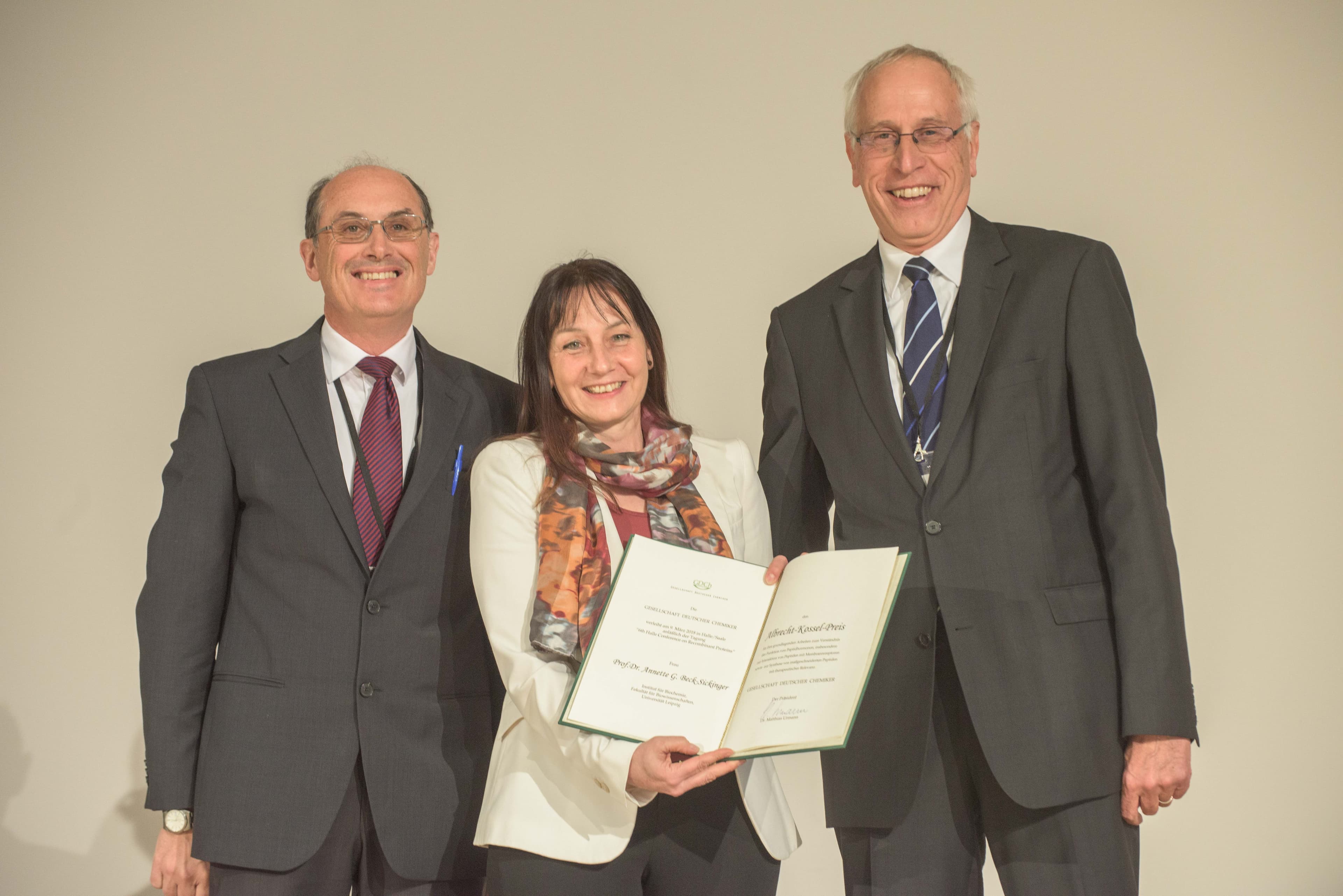
The Albrecht-Kossel Award (GDCh Award) was presented to Prof. Dr Annette Beck-Sickinger during the Conferences.
Molecules of Life - Molecules in Life
Together with the GDCh Divisions Liebig-Vereinigung and Medicinal Chemistry as well as the Joint Working Group Chemical Biology the Division of Biochemistry organised the sessions "Molecules of Life - Molecules in Life". Programme
From 16 to 18 July 2014, the Division of Biochemistry of the GDCh, together with the DFG Priority Programme 1623 "Chemoselective Reactions for the Synthesis and Application of Functional Proteins", organised a Conference on "Bioorthogonal Chemistry" in the newly renovated Harnackhaus of the Max Planck Society in Berlin-Dahlem.
Bioorthogonal chemistry forms the foundation of many modern detection and visualisation methods in cell and molecular biology as well as in numerous areas of medicine. High-throughput sequencing and "omics" research would not exist without bioorthogonal chemistry. New biomaterials, artificial genetic systems and artificial metabolic pathways are other important areas of research related to this topic. The 150 participants at the Conference, including numerous doctoral students, engaged in lively discussions in thematically focused sessions on established and new reactions for the modification and labelling of biomolecules in vitro and on the visualisation and labelling of biomolecules in living cells. The second half of the Conferences focussed on the interplay between chemistry and proteomics, RNomics and glycomics as well as synthetic biology and new biomaterials. In total, there were 6 plenary lectures and 23 short lectures, and 19 of the 59 registered posters were selected to be presented in three-minute short presentations.
The programme began with a plenary lecture by Floris van Delft (Nijmegen, NL) on site-specific conjugation of glycoproteins, a topic with high current relevance in pharmaceutical research. Tom Brown (Oxford, UK) reported on the chemistry and biochemistry of click ligation of nucleic acids Itaru Hamachi (Kyoto, JP) presented chemical strategies for labelling and manipulating proteins in living cells, while Hermen Overkleeft (Leiden, NL) reported on activity-based protein profiling of proteases and glycosidases. Two further highly interesting plenary lectures were given by Wilfried Weber (Freiburg) on smart biohybrid materials and Phil Holliger (Cambridge, UK) on synthetic genetics.
An undoubted highlight of the event was the first presentation of the Albrecht-Kossel Award, which was carried out by the President of the GDCh, Dr Thomas Geelhaar. The prizewinner Prof Dr Roland Lill (Marburg) gave an inspiring lecture on the biogenesis of iron-sulphur proteins in eukaryotes.
Overall, the Conference illuminated the interface between chemistry and the biosciences in an inspiring way.
Andres Jäschke (Heidelberg), Christian Hackenberger (Berlin)