
Career
Career orientation
Job market
Salary information and income survey
Academy
Mentoring
Education
Learners and trainees
Students and doctoral candidates
Teachers
University statictics
Scholarships
Community
Divisions
Local Sections
Regular's table
Chem_Connect
Equal opportunities, diversity
International activities and cooperations
Membership
Discover
Top topics
Nachrichten aus der Chemie
Brochures and scientific publications
Fascination with chemistry
Statements and position papers
Press releases
Events
Conferences
Local events
Academy
Awards
Prizes
Historical sites of chemistry
About
Board and other bodies
Office
Statutes
Angewandte Chemie and Chemistry Europe
Foundations
ChemRXiv
Biography Peyerimhoff
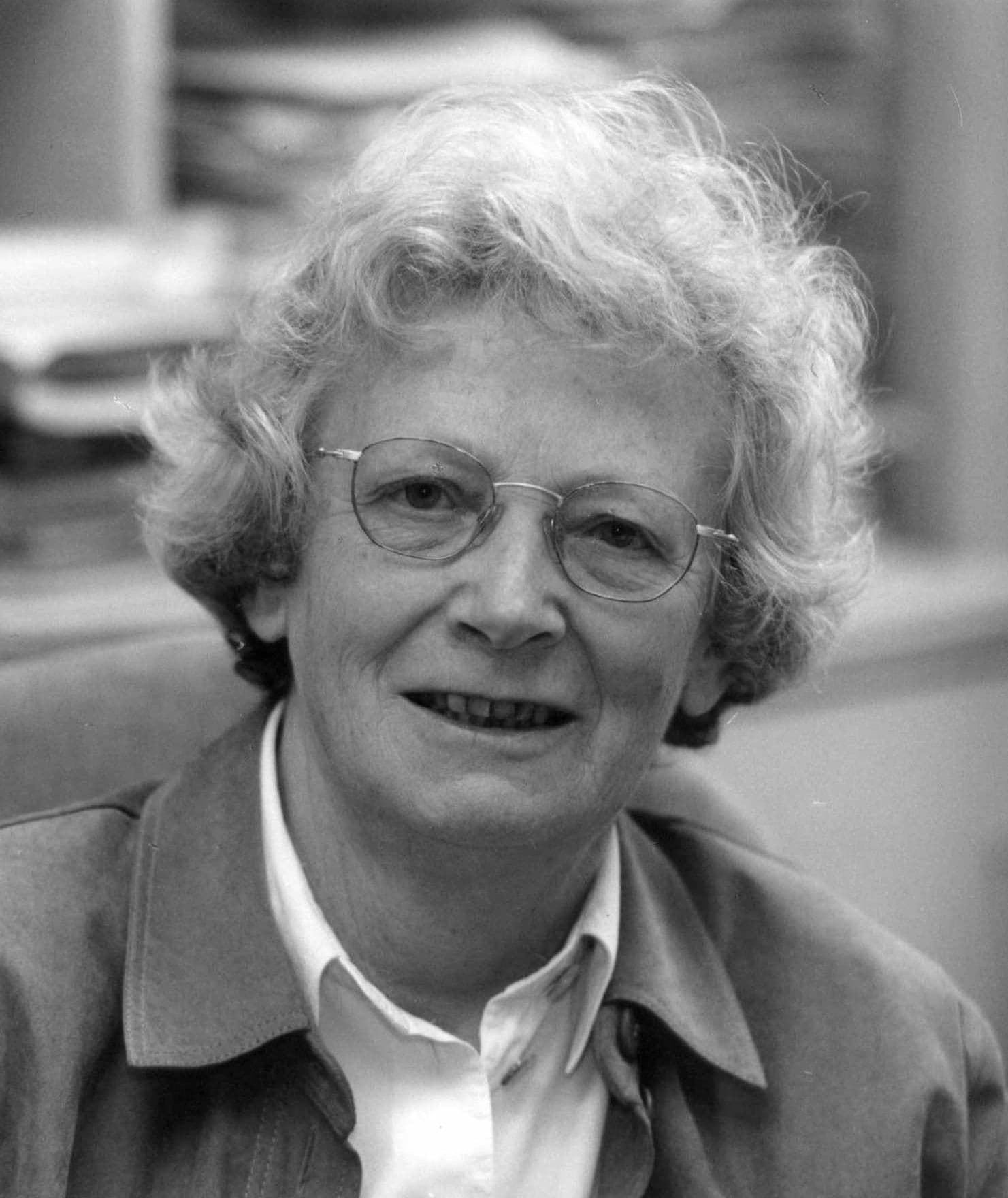
Sigrid Peyerimhoff studied physics, but was already working on quantum chemical calculations in her doctoral thesis. In 1972, she became Professor of Physical and Theoretical Chemistry at the University of Bonn. For a long time, she remained the only woman to hold such a chair.
Sigrid Peyerimhoff was born on 12 January 1937 in Rottweil, the oldest town in Baden-Württemberg. She grew up in Heidenheim an der Brenz, where she graduated from high school in 1956. She then decided to study physics at the Justus Liebig University in Giessen, where she graduated in 1961. Her academic teachers included the well-known physicist Wilhelm Hanle (1901-1993), a student of James Franck (1882-1964). The latter was awarded the Nobel Prize for Physics in 1925 together with Gustav Hertz.
In her doctoral thesis at the University of Giessen, Peyerimhoff worked on quantum chemical calculations of the hydrogen fluoride molecule under the supervision of Bernhard Kockel (1909-1987), Professor of Theoretical Physics. She received her doctorate in 1963.
As a postdoctoral researcher, Peyerimhoff conducted research in the USA until 1967. As a Volkswagen Foundation scholarship holder, she initially worked at the University of Chicago with Clemens Roothaan (1918-2019) and Robert Mulliken (1896-1986). Mulliken was awarded the Nobel Prize in Chemistry in 1966 for his fundamental contributions to the electron structure of molecules and chemical bonding. Further research stays took Peyerimhoff to Washington State University in Seattle and then - with a leave of absence from her work in Giessen - to Princeton University in New Jersey and Michigan State University.
In 1967, she completed her habilitation in theoretical physics at the University of Giessen. She then taught as a lecturer in Giessen for another two years before moving to Mainz as a scientific counsellor and professor. During this time, she spent several guest stays in the USA at the University of Nebraska-Lincoln in Lincoln. There, she and the US chemist Robert Buenker (born 1942) had a powerful computer at their disposal for the complex calculations. Peyerimhoff had worked with Buenker, who had previously been a visiting professor in Giessen and Mainz, for many years. In her mid-thirties, in 1972, Peyerimhoff accepted an appointment to the Chair of Physical and Theoretical Chemistry at the Rheinische Friedrich-Wilhelms-Universität Bonn. For a long time, she remained the only woman in Germany to hold such a chair.
Peyerimhoff made fundamental contributions to ab-initio calculations in quantum chemistry. This refers to methods for solving the Schrödinger equation using only natural constants. This work was also important for environmentally relevant reactions in the atmosphere, for example ozone. In total, Peyerimhoff published around 500 studies in scientific journals and edited volumes. In 1988, she received the Leibniz Prize from the German Research Foundation, one of the most important German Young Scientist Awards. In 2002, she was awarded emeritus status at the University of Bonn.
In addition, Peyerimhoff took on important tasks and functions in scientific societies and committees. She was a founding member of the Academy of Sciences in Berlin in 1987 and Vice President of the German Research Foundation from 1990 to 1996. In 1999, she was appointed a member of the German Academy of Sciences Leopoldina, which awarded her the Cothenius Medal for her life's work in 2007. Peyerimhoff is also a member of the German Academy of Science and Engineering, the Academia Europaea and the North Rhine-Westphalian Academy of Sciences, Humanities and the Arts. From 2006 to 2009, she was President of the International Academy of Quantum Molecular Science, to which she was elected in 1986.
In 2008, Peyerimhoff was honoured with the Grand Cross of the Order of Merit of the Federal Republic of Germany. The oldest German scientific society, the Society of German Natural Scientists and Physicians, founded in 1822, awarded her the Alexander von Humboldt Medal in 2018.
The Bonn University Foundation has been awarding the Sigrid Peyerimhoff Young Scientist Award and the Sigrid Peyerimhoff Research Award since 2020. The prize not only honours outstanding research, explained the founder Peyerimhoff on the occasion of the establishment of the endowment fund: "It is also a sign of encouragement and encouragement to find the path into science and to dare to take it. A path that has given me so much myself." Since 2021, the Working Group Theoretical Chemistry of the German Chemical Society has also honoured outstanding doctoral theses in the field of theoretical chemistry with the Sigrid Peyerimhoff PhD Award.
Currently: In 2022, the GDCh honoured Sigrid Peyerimhoff with the Erich Hückel Award. To the interview with the award winner (published in "Nachrichten aus der Chemie", April 2022)
.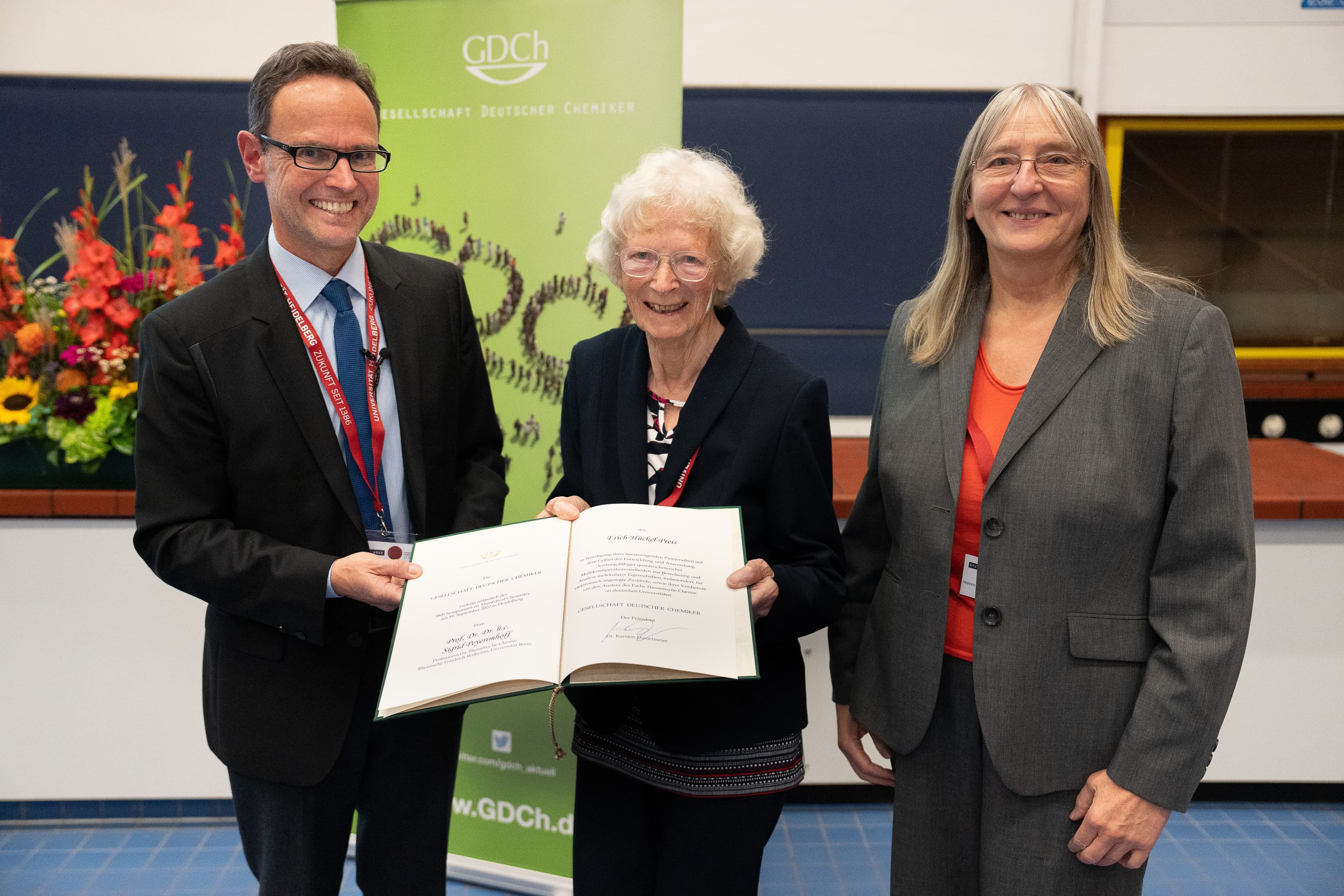
September 2022: Prof Sigrid Peyerimhoff (centre) at the award ceremony with GDCh Past President Prof Peter R. Schreiner and laudator Prof Christel Marian.
Authors
Prof. Dr Eberhard Ehlers
Prof. Dr Heribert Offermanns
Editing
Dr. Uta Neubauer
Project management
Dr. Karin J. Schmitz (GDCh public relations)
The authors are responsible for the content of the biographies.
The content presented on these pages has been carefully compiled. However, the authors, Editorial staff and publishers assume no responsibility or liability for the completeness and accuracy of the content or for typographical errors.