
Career
Career orientation
Job market
Salary information and income survey
Academy
Mentoring
Education
Learners and trainees
Students and doctoral candidates
Teachers
University statictics
Scholarships
Community
Divisions
Local Sections
Regular's table
Chem_Connect
Equal opportunities, diversity
International activities and cooperations
Membership
Discover
Top topics
Nachrichten aus der Chemie
Brochures and scientific publications
Fascination with chemistry
Statements and position papers
Press releases
Events
Conferences
Local events
Academy
Awards
Prizes
Historical sites of chemistry
About
Board and other bodies
Office
Statutes
Angewandte Chemie and Chemistry Europe
Foundations
ChemRXiv
Biography Becke-Goering
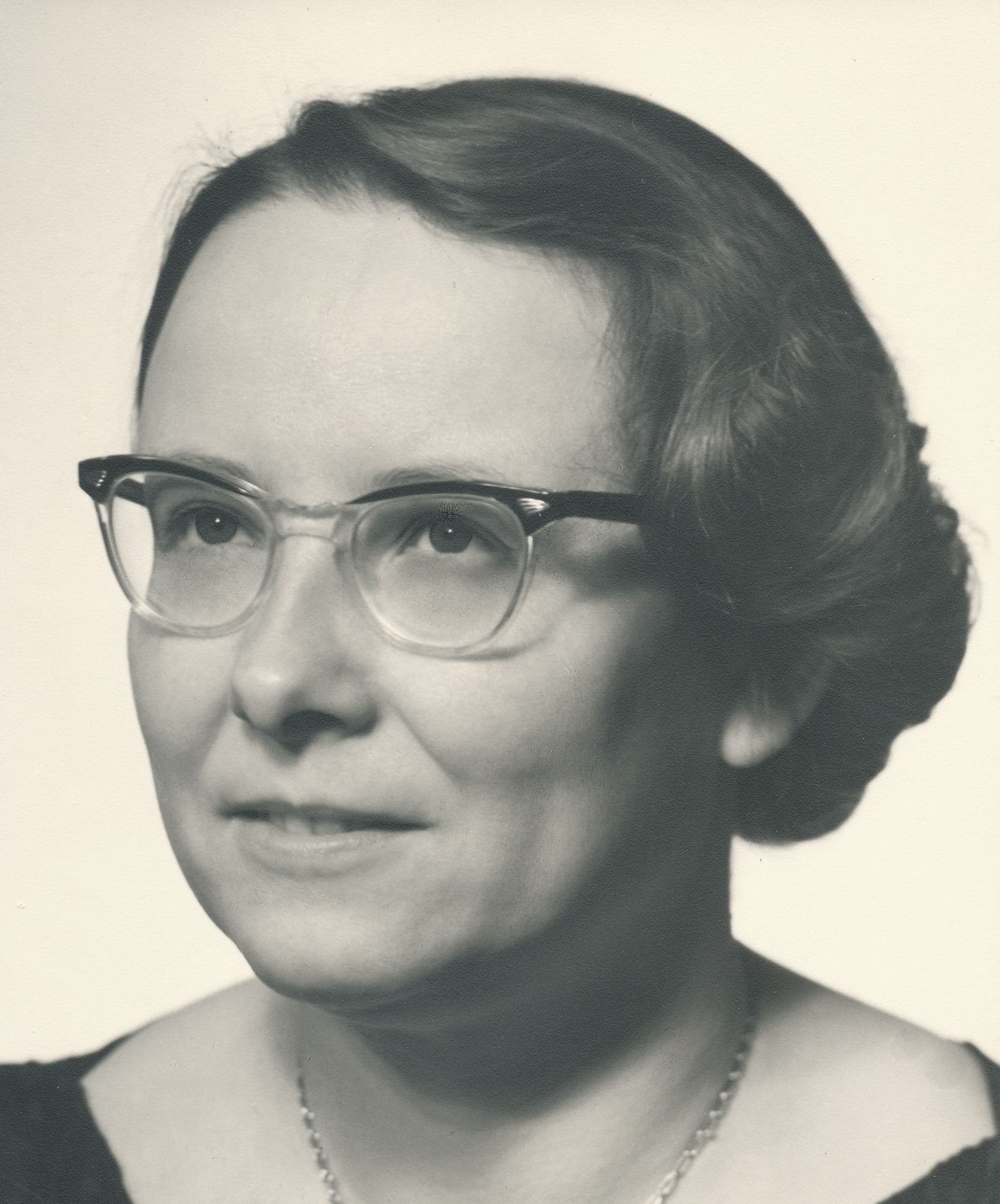
During her Career, Margot Becke-Goehring held several positions that had previously only been held by men. She was the first female dean and rector in the history of Heidelberg University. After leaving the university, she headed the Gmelin Institute in Frankfurt am Main.
Margot Becke-Goehring was born on 10 June 1914 in Allenstein, East Prussia. She went to school in Gera and Erfurt, where she passed her A-levels in 1933. She then studied chemistry in Halle and Munich - against her parents' wishes. "Physically too hard, no opportunities for a woman," said her father, the career officer Albert Goehring. But this judgement turned out to be wrong. Just five years after leaving school, his daughter received her doctorate from the University of Halle as an academic student of inorganic chemist Hellmuth Stamm (1901-1977). She continued her research in Halle and habilitated in 1944 at the institute of the later Nobel Prize winner Karl Ziegler (1898-1973) with a paper on sulphoxylic acid. "The time of my first own work was so full of science that when I think back today, I almost forget that there was a war," Becke-Goehring later said about the early years of her Career.
At the University of Heidelberg, she was initially given a lecturer position in 1946, but the following year she was already given an associate professorship for inorganic and analytical chemistry. At a meeting of the Heidelberg Chemical Society in 1955, she met her future husband, the industrial chemist Friedrich Becke (1910-1972). After their marriage, Becke-Goehring continued her career at the University of Heidelberg. In 1959, she became a full professor and in 1961 was the first woman to become Dean of the Faculty of Natural Sciences and Mathematics there. But that was not all: in 1966, she crowned her academic career by being elected Rector of Heidelberg University. This made her the first female rector of a West German university.
The rectorate came at a time of upheaval, which Becke-Goehring helped to shape. Among other things, she initiated new curricula and campaigned for student funding, which later developed into the Federal Training Assistance Act (Bafög). The student unrest of the 1960s, which was very pronounced in Heidelberg, presented the chemist with a considerable challenge. Becke-Goehring described the "masses with raised fists, ready for violence" as oppressive, but at the same time emphasised in retrospect: "I was able to say what I had to say, to make my legal position clear. ... You could still assert yourself back then if you had a little courage; you could stand up for the rule of law without the police." However, when it became apparent that the university's new constitution contradicted her ideas, she resigned from her post and shortly afterwards resigned from her civil servant position. In 1969, she left the University of Heidelberg.
From 1969 until her retirement ten years later, Becke-Goehring headed the Gmelin Institute for Inorganic Chemistry and Frontier Areas in Frankfurt am Main. The main purpose of the institute, which was part of the Max Planck Society, was to publish Gmelin's Handbook of Inorganic Chemistry. Until the institute was dissolved in 1997, the work brought together the entire state of knowledge of inorganic chemistry.
Becke-Goehring was honoured several times for her services. She was the first woman to receive the Alfred-Stock Memorial Award from the GDCh in 1961 and the Gmelin-Beilstein-Denkmünze in 1980. The University of Stuttgart awarded her an honorary doctorate.
Margot Becke-Goehring died in Heidelberg on 14 November 2009 at the age of 95. Her life's work has been preserved for posterity in many books and over 300 scientific publications, primarily on sulphur, phosphorus and nitrogen chemistry.
Sources
H. Eberle: Die Martin-Luther-Universität in der Zeit des Nationalsozialismus, Mdv, Halle, 2002, p. 412, ISBN 3-89812-150-X
E. Fluck: Margot Becke, obituary in the Annual Report of the Max Planck Society, 2009, supplement, pp. 18-19
M. Becke-Goehring, D. Mussgnug: Memories - almost blown away by the wind. Universität Heidelberg zwischen 1933-1968, Verlag Dieter Winkler, Bochum, 2005
German Chemical Society (GDCh): Chemikerinnen - es gab und es gibt sie, brochure, 2003, p. 23
Authors
Prof. Dr Eberhard Ehlers
Prof. Dr Heribert Offermanns
Editing
Dr. Uta Neubauer
Project management
Dr. Karin J. Schmitz (GDCh public relations)
The authors are responsible for the content of the biographies.
The content presented on these pages has been carefully compiled. However, the authors, Editorial staff and publishers assume no responsibility or liability for the completeness and accuracy of the content or for typographical errors.