
Career
Career orientation
Job market
Salary information and income survey
Academy
Mentoring
Education
Learners and trainees
Students and doctoral candidates
Teachers
University statictics
Scholarships
Community
Divisions
Local Sections
Regular's table
Chem_Connect
Equal opportunities, diversity
International activities and cooperations
Membership
Discover
Top topics
Nachrichten aus der Chemie
Brochures and scientific publications
Fascination with chemistry
Statements and position papers
Press releases
Events
Conferences
Local events
Academy
Awards
Prizes
Historical sites of chemistry
About
Board and other bodies
Office
Statutes
Angewandte Chemie and Chemistry Europe
Foundations
ChemRXiv
Biography Faulstich
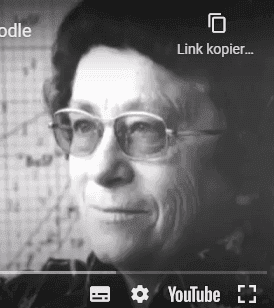
Marga Faulstich conducted research for the Schott company for over four decades. She developed lightweight spectacle lenses and numerous optical glasses for telescopes and microscopes.
On 16 June 2018, anyone who opened the Google search engine saw a dark-haired woman surrounded by laboratory equipment and glass vessels looking through two different coloured round glasses in the doodle - the modified Google logo (see below in the article). The US company used the illustration to commemorate the glass researcher Marga Faulstich, who would have been 103 years old on this day.
Born on 16 June 1915 in Weimar, Faulstich moved to Jena with her family in 1922. There she attended the Realgymnasium, which she completed with the Abitur. In 1935, she began training as a scientific assistant at the Schott glassworks in Jena. The company was one of the leading European manufacturers of optical and technical speciality glasses.
In her early years at Schott, Faulstich worked on thin glass coatings. In 1939, the research group in which she was involved filed a patent that has since served as the basis for the production of sunglasses, anti-reflective lenses and glass facades. A further 40 patents used worldwide with Faulstich's involvement followed over time.
Faulstich quickly made a career at Schott: she rose from scientific assistant to laboratory assistant, then to scientific assistant and finally to independent researcher. After the death of her fiancé during the Second World War, she devoted herself exclusively to her professional life. In addition to her work at Schott, she began studying chemistry at the Friedrich Schiller University in Jena in 1942. However, in the turmoil of the war, she was unable to complete her studies with a degree.
After the Second World War, Jena, famous worldwide for its advanced glassmaking skills, belonged to the Soviet occupation zone. As the Western Allies wanted to benefit from the accumulated knowledge and expertise of the glass industry, they brought 41 specialists and managers, including Faulstich, to the American occupation zone. As early as 1949, a provisional research laboratory was set up in Landshut, Bavaria.
After the expropriation of the Schott factory in Jena in 1948 and the division of Germany the following year, the entrepreneur Erich Schott (1891-1989) negotiated with the city of Mainz to relocate the glassworks to the site of a former abattoir. In May 1952, a new Schott plant started production there.
Faulstich became the first female manager at Schott in Mainz. She researched and developed new glasses, especially special glasses for microscopes and telescopes, and managed a crucible smelter for 16 years in addition to her research activities. She gained international recognition in particular for the invention of the lightweight Schwerflint 64 (SF 64) spectacle lens. Instead of the heavy metal lead, it contains titanium and therefore weighs significantly less. The US Industrial Research Incorporation counted SF 64 among the hundred most important innovations of 1973 and awarded Faulstich the Industrial Research 100 Medal. In total, over 300 types of optical glass can be attributed to the inventiveness of this remarkable researcher.
After working for Schott for 44 years, Marga Faulstich retired in 1979. She died at the age of 82 on 1 February 1998 in Mainz.
Sources
Schott Glaswerke (publisher): From Jena to Mainz - and back. Schott history between the Cold War and German reunification, Mainz, 1995
Authors
Prof. Dr Eberhard Ehlers
Prof. Dr Heribert Offermanns
Editing
Dr. Uta Neubauer
Project management
Dr. Karin J. Schmitz (GDCh public relations)
The authors are responsible for the content of the biographies.
The content presented on these pages has been carefully compiled. However, the authors, Editorial staff and publishers assume no responsibility or liability for the completeness and accuracy of the content or for typographical errors.