
Career
Career orientation
Job market
Salary information and income survey
Academy
Mentoring
Education
Learners and trainees
Students and doctoral candidates
Teachers
University statictics
Scholarships
Community
Divisions
Local Sections
Regular's table
Chem_Connect
Equal opportunities, diversity
International activities and cooperations
Membership
Discover
Top topics
Nachrichten aus der Chemie
Brochures and scientific publications
Fascination with chemistry
Statements and position papers
Press releases
Events
Conferences
Local events
Academy
Awards
Prizes
Historical sites of chemistry
About
Board and other bodies
Office
Statutes
Angewandte Chemie and Chemistry Europe
Foundations
ChemRXiv
Biography Hess
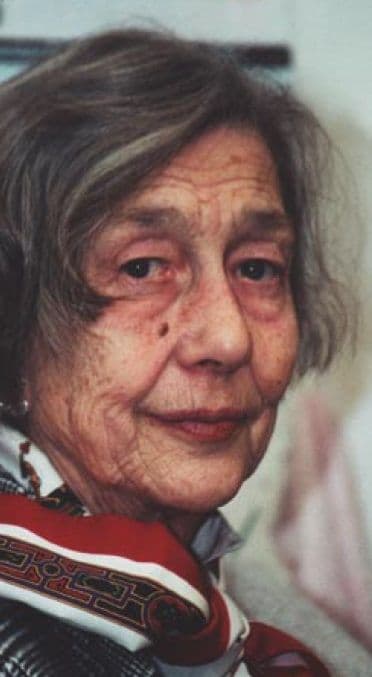
Hildegard Hess followed in her father's footsteps. She was already working for his analytics laboratory during her doctoral thesis at the Technical University of Berlin. She eventually took over and ran it for three decades.
Hildegard Hess was born in 1920 in the Berlin neighbourhood of Britz. Her father Ludwig Hess (1882-1956) was the director of a factory belonging to the chemical company Riedel de Haën, while her mother Hertha was a trained nurse. As the family lived in a staff flat on the factory premises at the time, Hess came into contact with chemistry at an early age. In 1931, her father took over a chemical testing laboratory as a state-approved food chemist and commercial chemist.
Hess attended a convent school and was therefore exempt from membership of the Bund Deutscher Mädel. She passed her A-levels in 1939 - shortly before the school was closed by the National Socialists. She then began studying chemistry at the Friedrich Wilhelm University in Berlin, but soon transferred to the Albert Ludwig University in Freiburg. She completed her training in 1944 at the Berlin Reichsanstalt für Lebensmittelchemie und Arzneimittelchemie. Her academic teachers included Hermann Staudinger (1881-1965) and Georg Wittig (1897-1987), who later won the Nobel Prize for Chemistry. "It was under Professor Wittig that I first really understood chemistry," said Hess looking back. With his enthusiasm, he was her most wonderful teacher.
After graduating, Hess joined her father's commercial laboratory. Alongside this work, she completed her doctorate under Josef Schormüller (1903-1974) at the Institute of Food Chemistry at the Technical University of Berlin on the content of vitamins in the mycelium of microorganisms. She was awarded her doctorate in 1953. One year later, she was publicly appointed and sworn in as a commercial chemist. This authorised Hess to work as a consultant and expert for manufacturers and retailers in the chemical industry. She was the first woman to hold this position in Berlin, and probably even in Germany.
After the death of her father in 1956, Hess took over his commercial laboratory and ran it for three decades. In 1986, the laboratory merged with the Institut Kirchhoff Berlin, a service company for analytics founded three years earlier, which still exists today.
In addition to her work as an independent chemist, Hess taught at the TU Berlin, where she held a lectureship in nutritional sciences from 1955 to 1965. She also gave courses for food retailers. Hildegard Hess died in Berlin on 23 July 2014 at the age of 84.
Sources
German Chemical Society (GDCh): Chemikerinnen - es gab sie und es gibt sie, 2003, p. 26
G. Boeck, Nachrichten aus der Chemie 51, 2003, p. 67
Authors
Prof. Dr Eberhard Ehlers
Prof. Dr Heribert Offermanns
Editing
Dr. Uta Neubauer
Project management
Dr. Karin J. Schmitz (GDCh public relations)
The authors are responsible for the content of the biographies.
The content presented on these pages has been carefully compiled. However, the authors, Editorial staff and publishers assume no responsibility or liability for the completeness and accuracy of the content or for typographical errors.