
Career
Career orientation
Job market
Salary information and income survey
Academy
Mentoring
Education
Learners and trainees
Students and doctoral candidates
Teachers
University statictics
Scholarships
Community
Divisions
Local Sections
Regular's table
Chem_Connect
Equal opportunities, diversity
International activities and cooperations
Membership
Discover
Top topics
Nachrichten aus der Chemie
Brochures and scientific publications
Fascination with chemistry
Statements and position papers
Press releases
Events
Conferences
Local events
Academy
Awards
Prizes
Historical sites of chemistry
About
Board and other bodies
Office
Statutes
Angewandte Chemie and Chemistry Europe
Foundations
ChemRXiv
Biography Cremer
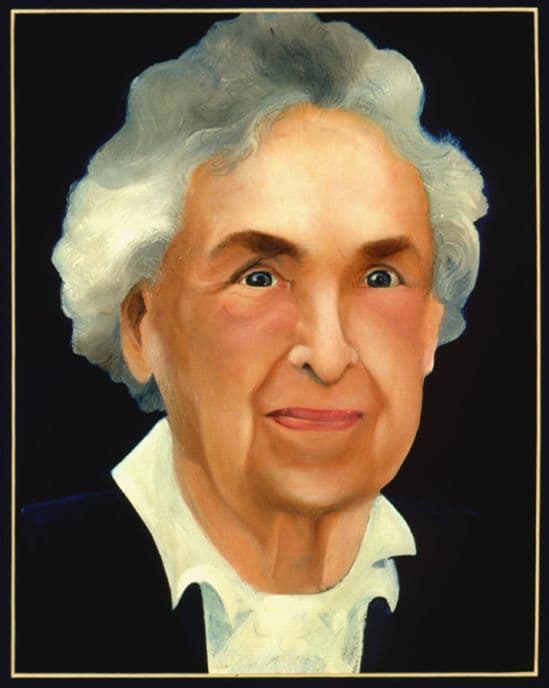
Her father encouraged her scientific and technical talent, laying the foundations for a career in chemistry. However, she did not receive the international recognition that Erika Cremer deserved.
Erika Cremer was born in Munich on 20 May 1900. Her father Max Cremer (1865-1935) was a well-known physiology professor who helped develop the glass electrode. He encouraged his children's interest in science and technology early on and with success: Erika Cremer, later Professor of Physical Chemistry at the University of Innsbruck, was not the only one to make a career in science. Her older brother Hubert (1897-1983) became Professor of Mathematics and Large Computer Systems at RWTH Aachen University, while her younger brother Lothar (1905-1990) was Professor of Technical Acoustics at TU Berlin and also Director of the Heinrich Hertz Institute of the Fraunhofer-Gesellschaft.
When Max Cremer accepted an appointment to Berlin University in 1911, the entire family moved to the German capital. Cremer passed her A-levels in 1920 at a college for young women, where the natural sciences were highly valued. She then studied chemistry, physics and maths in Berlin. Her doctoral thesis, in which she researched the chlorine oxyhydrogen reaction, was supervised by the renowned physical chemist Max Bodenstein (1871-1942). She obtained her doctorate in 1927.
In her years of scientific travelling, the young chemist mostly worked unpaid, for example with the later Nobel Prize winner Georg Karl von Hevesy (1885-1966) in Freiburg and Michael Polanyi (1891-1976) at the Kaiser Wilhelm Institute (KWI) for Physical Chemistry and Electrochemistry in Berlin. In 1936, Cremer returned to her actual research focus, the explosive chain reaction between hydrogen and chlorine. Among others, she worked with Otto Hahn (1879-1968) at the KWI for Chemistry in Berlin. In 1989, she wrote the highly acclaimed article "Zur Geschichte der Entfesselung der Kernenergie" in the Österreichischen Chemiker-Zeitung about this time.
In 1939, Cremer completed her habilitation against the will of the dean. The following year, she moved to the Leopold Franzens University in Innsbruck, where she was authorised to teach and at the same time became a civil servant on revocation - but initially without pay. In 1945, she took over the provisional management of the Institute of Physical Chemistry. Six years later, she was appointed associate university professor and head of the institute. It was not until 1959 - more than three decades after completing her doctoral thesis - that the University of Innsbruck appointed Cremer as a full professor of physical chemistry. She held this professorship until her retirement in 1970.
Erika Cremer is regarded as the inventor of gas chromatography, the scientific foundations of which she developed primarily together with her student Fritz Prior. Although Cremer published over 200 scientific articles, international recognition was slow and delayed. While the two British chemists Archer J. P. Martin (1910-2002) and Richard L. M. Synge (1914-1994) received the Nobel Prize for Chemistry in 1952 for their work on gas, column and paper chromatography, Cremer was left empty-handed. Nevertheless, she was instrumental in the development of new analytical techniques. The technical realisation of the methods she developed was always close to Cremer's heart, which is why she cooperated with chemical and pharmaceutical companies as well as manufacturers of analytical equipment.
Cremer never married and remained childless. She devoted all her energy to research and teaching. During her time in Innsbruck, she supervised over 70 doctoral students and four post-doctoral students. One of her students described her style as follows: "She loved chaos, entropy was always a favourite term. She had ideas, she was brilliant, that was her strength." Erika Cremer died on 21 September 1996 in Innsbruck.
Sources
G. Oberkofler: Erika Cremer (1900-1996) - Ein Leben für die Chemie, published by the Central Library for Physics in Vienna, Studien-Verlag Innsbruck/Vienna/Bolzano, 1998
B. Bischof: Cremer, Erika, in: B. Keintzel, I. Korotin (editors): Women Scientists in and from Austria. Leben - Werk - Wirken, Böhlau Verlag, Vienna/Cologne/Weimar, 2002, pp. 121-124, ISBN 3-205-99467-1
German Chemical Society (GDCh): Chemikerinnen - es gab sie und es gibt sie, brochure, 2003, p. 17
Authors
Prof. Dr Eberhard Ehlers
Prof. Dr Heribert Offermanns
Editing
Dr. Uta Neubauer
Project management
Dr. Karin J. Schmitz (GDCh public relations)
The authors are responsible for the content of the biographies.
The content presented on these pages has been carefully compiled. However, the authors, Editorial staff and publishers assume no responsibility or liability for the completeness and accuracy of the content or for typographical errors.