
Career
Career orientation
Job market
Salary information and income survey
Academy
Mentoring
Education
Learners and trainees
Students and doctoral candidates
Teachers
University statictics
Scholarships
Community
Divisions
Local Sections
Regular's table
Chem_Connect
Equal opportunities, diversity
International activities and cooperations
Membership
Discover
Top topics
Nachrichten aus der Chemie
Brochures and scientific publications
Fascination with chemistry
Statements and position papers
Press releases
Events
Conferences
Local events
Academy
Awards
Prizes
Historical sites of chemistry
About
Board and other bodies
Office
Statutes
Angewandte Chemie and Chemistry Europe
Foundations
ChemRXiv
Biography Wolffhardt
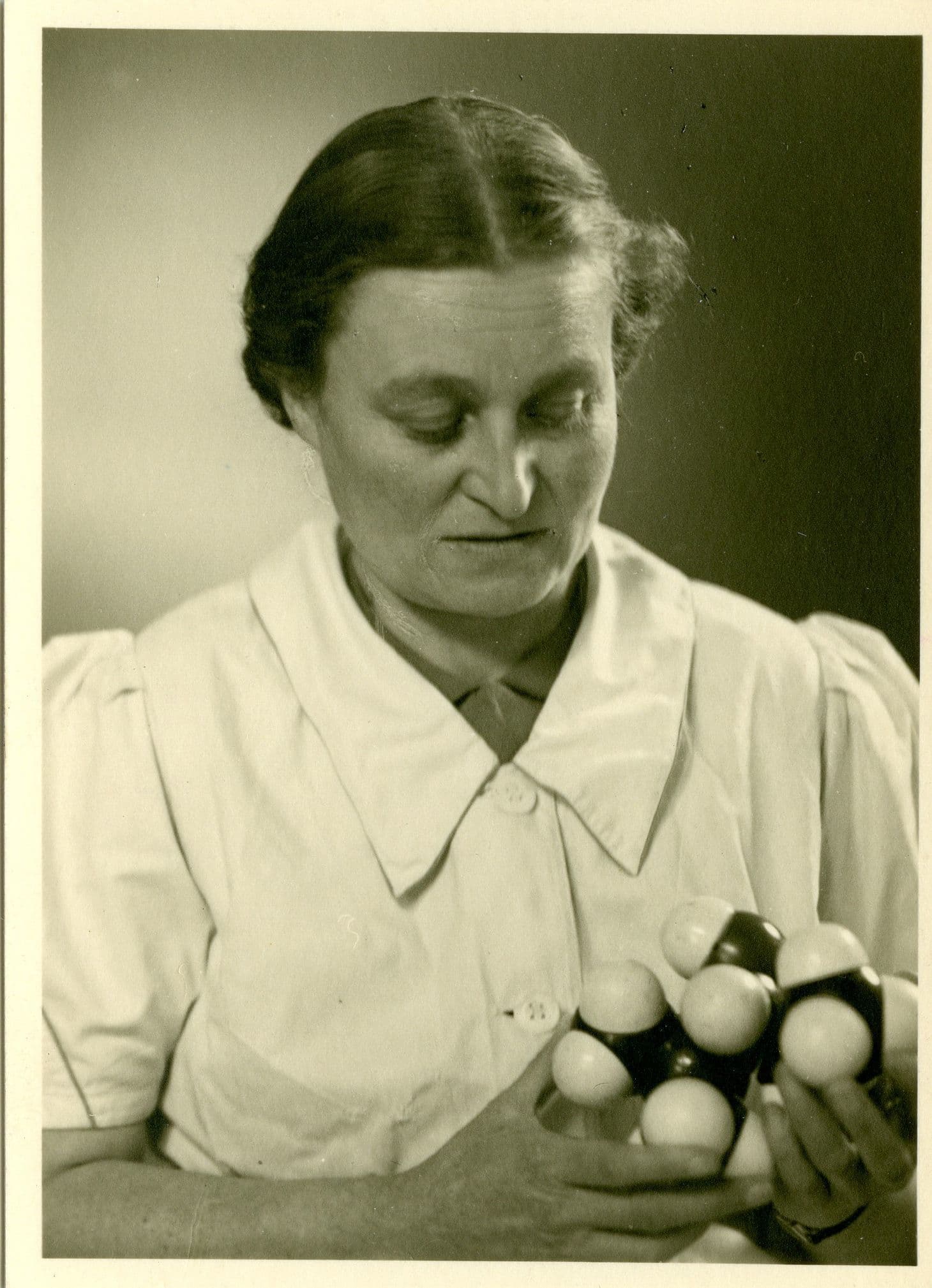
Emma Maria Wolffhardt was the first woman to head her own research area at BASF. She worked for the company from 1925 to 1960 and developed a knock-resistant aviation fuel in the ammonia laboratory there.
Born on 27 July 1899, Emma Maria Wolffhardt studied chemistry at the University of Würzburg and then worked as an assistant at the Technical University of Karlsruhe. She completed her doctoral thesis under Stefan Goldschmidt (1899-1971), a student of the well-known chemist and Nobel Prize winner Adolph von Baeyer (1835-1917). Goldschmidt, who researched the chemistry of radicals, had been awarded an adjunct professorship in Würzburg in 1923, but shortly afterwards accepted an appointment as Head of Organic Chemistry in Karlsruhe.
Wolffhardt joined the chemical company BASF in Ludwigshafen in July 1925. Her first job was in the literature office of the main laboratory. She soon successfully applied for an assistant position with Alwin Mittasch (1869-1953), Head of the ammonia laboratories at the time. Mittasch was known for his work on catalysts for ammonia synthesis.
From 1940, Wolffhardt was the first woman to head her own research area at BASF. She was the first female researcher to recognise the value of the calotte model for the development of catalysts. The calotte model, developed a few years earlier by the physicist Herbert A. Stuart (1899-1974), visualises the three-dimensional shape of molecules. It represents the atoms of a molecule using spherical sections (calottes), whereby the different chemical elements appear in different colours and the atomic sizes, bond angles and bond lengths correspond to the actual ratios. Wolffhardt used the calotte model primarily to understand and improve organic synthesis. In this way, she succeeded for the first time in producing significant quantities of 2,2,3-trimethylbutane (triptan), a high-quality, knock-resistant aviation fuel with an octane rating of 112.
In the history of BASF, Wolffhardt was not only the first female academic with her own field of research, but also the first woman to celebrate 25 years of service at the company. After this service anniversary in 1950, she continued her research in the ammonia laboratory at BASF for a further ten years - until her retirement in 1960.
Emma Maria Wolffhardt died on 12 November 1997 in Heidelberg at the age of 98.
Sources
E. Wolffhardt, Chemische Berichte 80, No. 1, 1947, pp. 64-76
R. Tobies (ed.): "Aller Männerkultur zum Trotz": Frauen in Mathematik und Naturwissenschaften, Campus Verlag, 1997, p. 58 f.
BASF SE: Die Anilinerinnen, brochure, Ludwigshafen, 2017 (https://www.basf.com/global/de/who-we-are/history.html)
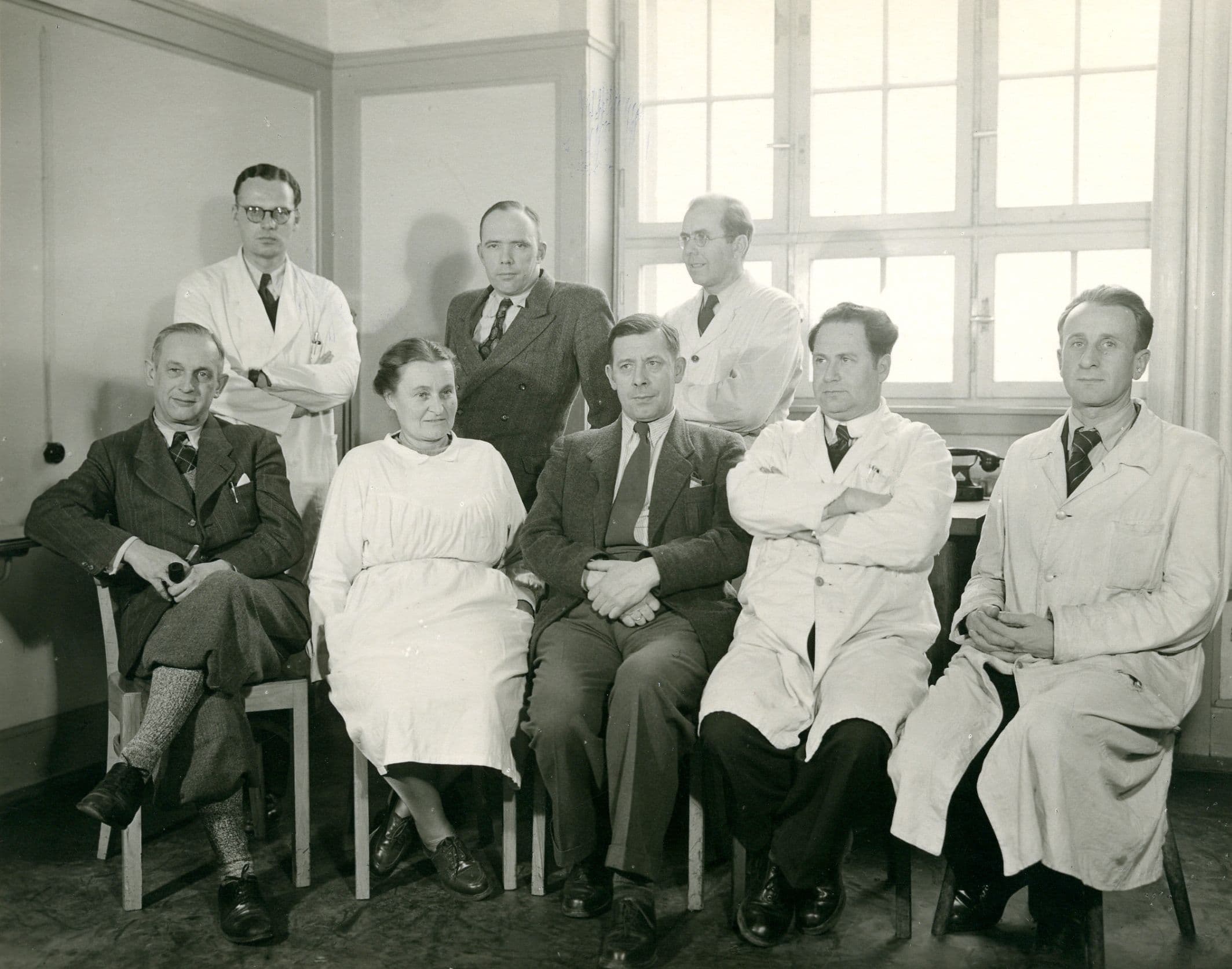
Emma Wolffhardt and colleagues in the ammonia laboratory, ca. 1951
Authors
Prof. Dr Eberhard Ehlers
Prof. Dr Heribert Offermanns
Editing
Dr. Uta Neubauer
Project management
Dr. Karin J. Schmitz (GDCh public relations)
The authors are responsible for the content of the biographies.
The content presented on these pages has been carefully compiled. However, the authors, Editorial staff and publishers assume no responsibility or liability for the completeness and accuracy of the content or for typographical errors.