
Career
Career orientation
Job market
Salary information and income survey
Academy
Mentoring
Education
Learners and trainees
Students and doctoral candidates
Teachers
University statictics
Scholarships
Community
Divisions
Local Sections
Regular's table
Chem_Connect
Equal opportunities, diversity
International activities and cooperations
Membership
Discover
Top topics
Nachrichten aus der Chemie
Brochures and scientific publications
Fascination with chemistry
Statements and position papers
Press releases
Events
Conferences
Local events
Academy
Awards
Prizes
Historical sites of chemistry
About
Board and other bodies
Office
Statutes
Angewandte Chemie and Chemistry Europe
Foundations
ChemRXiv
Biography Immerwahr
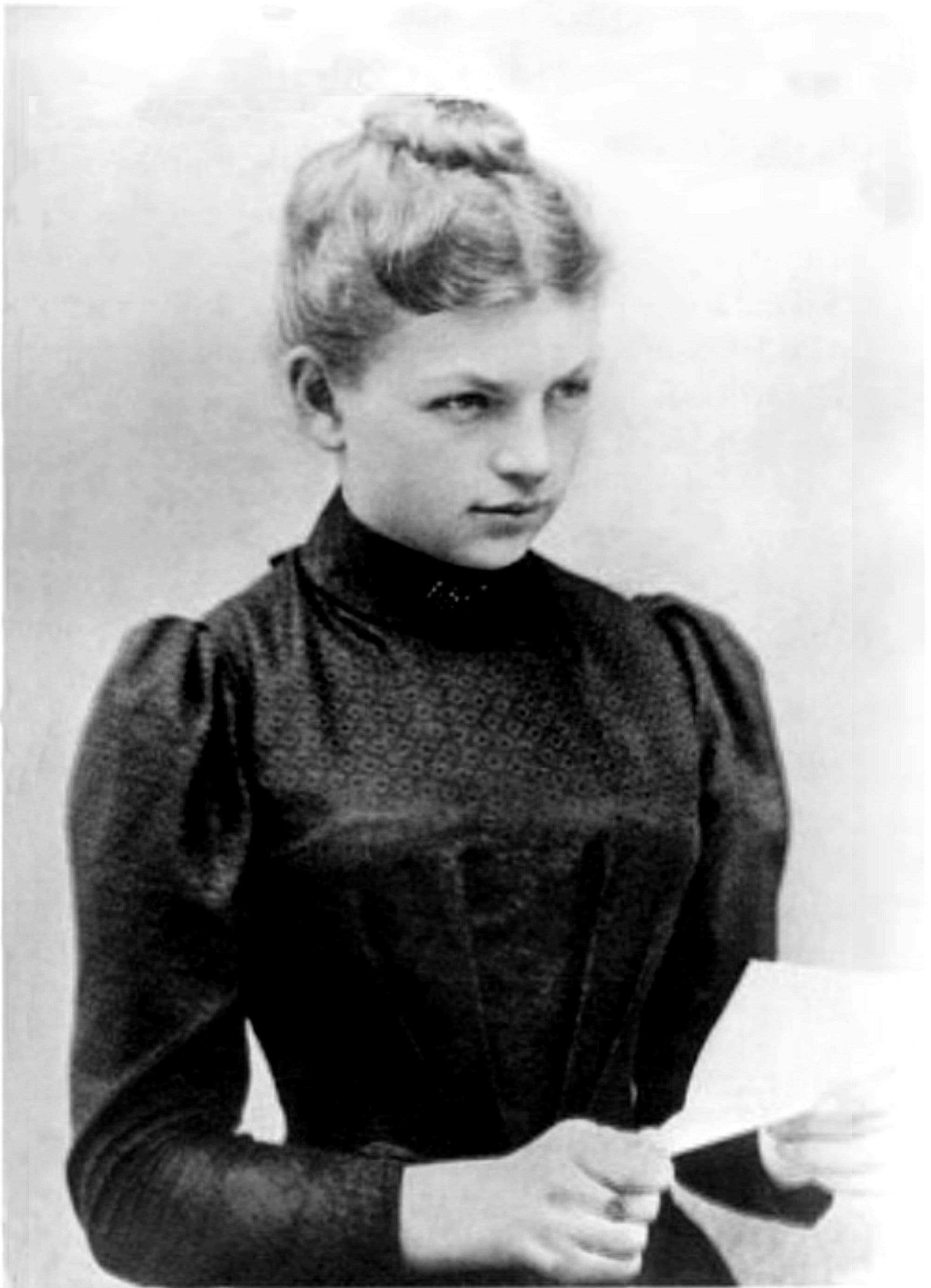
Clara Immerwahr was broken by the misogynistic scientific system and her marriage to the famous chemist Fritz Haber. After the birth of their son, she was forced to give up her career in research. She committed suicide at the age of 44.
Clara Immerwahr was born on 21 June 1870 as the youngest of four children of the chemist Philipp Immerwahr and his wife Anna on the Oswitz estate in Polkendorf in Lower Silesia (now Wojczyce in Polish). His father ran the estate and experimented with artificial fertilisers.
In summer, the Immerwahrs lived on the estate, where the children received private lessons. In winter, they lived 25 kilometres away in Breslau, the third-largest city in the German Reich at the time with a population of 240,000. Here, the three daughters attended a girls' secondary school. The liberal Head of the school recognised Clara's talent for science, encouraged her interest in chemistry and gave her a textbook entitled "Conversations on Chemistry". Immerwahr initially obtained the highest educational qualification for women as a teacher and worked as a governess for a time, as it was almost impossible for women to enter the domain of science at the time. Even A-levels and university studies were considered a male privilege.
However, with her intelligence and moral courage, persistence and diligence, Immerwahr prevailed. She attended the University of Wroclaw as a guest student. Although a physics professor made it clear that he thought "nothing of intellectual Amazons", he was unable to deter Immerwahr. She focussed on chemistry and gained access to the laboratories to carry out experiments. Professor Richard Abegg (1869-1910) from Breslau, chemist and pioneer of valence theory and the octet rule, recognised her abilities. He became her scientific mentor and later her doctoral supervisor. Immerwahr initially assisted him with his experiments. After passing her A-levels as an external pupil at a boys' grammar school in 1897, she was allowed to enrol as a full student. Three years later, at the age of 30, she was awarded a doctorate in physical chemistry with magna cum laude honours. The "Provinzial-Zeitung" newspaper in Breslau reported on 22 December 1900: "Our first female doctor. On Saturday afternoon at 12 noon, the doctorate of Miss Immerwahr took place in the Aula Leopoldina of our alma mater." Immerwahr was the first German female chemist to be awarded a doctorate - although not the first female chemist to be awarded a doctorate in Germany. The Russian chemist Julia Lermontova (1847-1919) had already received her doctorate from the University of Göttingen in 1874.
After her dissertation, Immerwahr initially took up an unpaid assistant position. She had once turned down a marriage proposal from her former dance class friend Fritz Haber (1868-1934). But when she met Haber again, who had also studied chemistry in Breslau, he asked her to marry him again. This time Immerwahr agreed and the two married in 1901, dreaming of a marriage modelled on that of Marie Skłodowska Curie (1867-1934) and her husband Pierre Curie (1859-1906), who researched and lived together in Paris.
The enthusiasm for chemistry was not the only thing Immerwahr and Haber had in common. Both came from Jewish families in Breslau, but had already converted to Protestantism before their marriage. At the time of their marriage, Haber was teaching and researching as an associate professor at the Technical University of Karlsruhe. Immerwahr worked in his laboratory until his son Hermann was born in 1902. While Haber continued to be absorbed in science, Immerwahr felt constricted in her role as housewife, mother and prestigious professor's wife. She wrote to her doctoral supervisor Abegg in 1909: "What Fritz has gained in these eight years, I have lost - and even more - and what is left of me fills me with the deepest dissatisfaction." Her hopes of becoming more involved in her husband's research again were not realised.
In 1910, the family moved from Karlsruhe to Berlin-Dahlem, where Haber became director of the Kaiser Wilhelm Institute for Physical Chemistry and Electrochemistry. After the start of the First World War, he began experimenting with combat gases and played a key role in planning their use as weapons of mass destruction. Immerwahr, on the other hand, publicly labelled the development of poison gases as a "perversion of science". The marriage fell into an ever-increasing crisis until the once so self-confident and assertive chemist no longer knew any way out. On 2 May 1915, Clara Immerwahr shot herself in the garden of the villa in Moltkestrasse with her husband's service weapon. In January 1937, her son Hermann had her urn reburied in his father's grave in Basel's Hörnli cemetery. Fritz Haber, who had received the Nobel Prize in Chemistry in 1918 for the synthesis of ammonia from nitrogen and hydrogen, had emigrated to England in 1933 and died of heart failure in a hotel in Basel in 1934 while travelling through to Israel.
Although Clara Immerwahr took her husband's name after her marriage, she is referred to in literature - and therefore also in this text - by her maiden name. She became known to a wider audience in 2014 through the ARD television film "Clara Immerwahr", which traces her life story and focuses primarily on misogyny in science at the beginning of the 20th century.
Sources
G. von Leitner: Der Fall Clara Immerwahr. Leben für eine humane Wissenschaft, Beck Verlag, Munich, 1994, 2nd edition
S. Friedrich: Immerwahr, dtv, Munich, 2007
German Chemical Society (GDCh): Chemikerinnen - es gab sie und es gibt sie, brochure 2003, p. 11
Authors
Prof. Dr Eberhard Ehlers
Prof. Dr Heribert Offermanns
Editing
Dr. Uta Neubauer
Project management
Dr. Karin J. Schmitz (GDCh public relations)
The authors are responsible for the content of the biographies.
The content presented on these pages has been carefully compiled. However, the authors, Editorial staff and publishers assume no responsibility or liability for the completeness and accuracy of the content or for typographical errors.